

Why These Three Paths Get Confused
When people talk about skipping a four-year degree, they often lump apprenticeships, trade programs, and community college together as if they're the same thing. They aren't. Each has a distinct structure, a different way of paying for itself, and a different kind of credential at the end. Mixing them up can mean choosing the wrong path - or ruling out a great one without fully understanding it.
This article maps the real differences so you can match each option to how you actually learn, what you want to earn, and how quickly you want to get there. For a broader look at how these paths fit into the overall U.S. education landscape, see our overview of the U.S. higher education system.
Apprenticeships: Work First, Learn as You Go
A registered apprenticeship is an employer-sponsored training arrangement. You are hired - not enrolled. From the first day, you work alongside experienced tradespeople, earning a wage that typically increases as your skills develop. Alongside that on-the-job experience, you complete related technical instruction (RTI), which may happen at a community college, a union training center, or online.
Apprenticeships are managed through employers, trade unions, or joint labor-management programs, and the best ones are registered with the U.S. Department of Labor or a State Apprenticeship Agency - a mark that guarantees wage standards and program quality. Trades that commonly use this model include electrical work, plumbing, ironwork, carpentry, and HVAC.
The biggest draw: you earn while you learn, often with no tuition cost at all. The trade-off is that entry can be competitive - you typically apply through the sponsoring employer or union, and spots are limited. For a realistic picture of the day-to-day experience, see what life actually looks like as an apprentice.
94%
Apprentice employment rate after completion
According to the U.S. Department of Labor, approximately 94% of apprentices who complete a registered program are employed afterward.
$70,000+
Median annual wage for registered apprenticeship completers
The U.S. Department of Labor reports that apprenticeship completers earn a median annual wage above $70,000 across trades.
Trade and Vocational Programs: School-Based, Skills-Focused
Trade and vocational programs are school-run training courses - offered by dedicated trade schools, vocational-technical (vo-tech) schools, or community colleges - that focus tightly on one occupation or skill set. You pay tuition, attend classes and hands-on labs, and earn a certificate or diploma at the end. Duration ranges from a few weeks (for targeted certifications) to two years for more comprehensive programs.
Common fields include medical assisting, welding, automotive technology, cosmetology, culinary arts, HVAC, and computer networking. Unlike apprenticeships, you do not earn a wage during training - but programs are often shorter, and you control your own schedule more directly.
Quality varies significantly between institutions. Before enrolling, check accreditation status and look up the school's completion and job-placement rates. Our guide to trade school and vocational programs covers fields, timelines, and career outcomes in depth.
Not All 'Trade Schools' Are Equally Regulated
Private vocational schools vary considerably in quality and cost. Some carry accreditation and strong job-placement records; others do not. Research each school's graduation rates, job-placement data, and accreditation status - this information is often available through the institution's consumer disclosures or the U.S. Department of Education's College Navigator tool. Unaccredited programs may leave you with a credential that employers or licensing boards don't recognize.
Community College: Breadth, Affordability, and Options
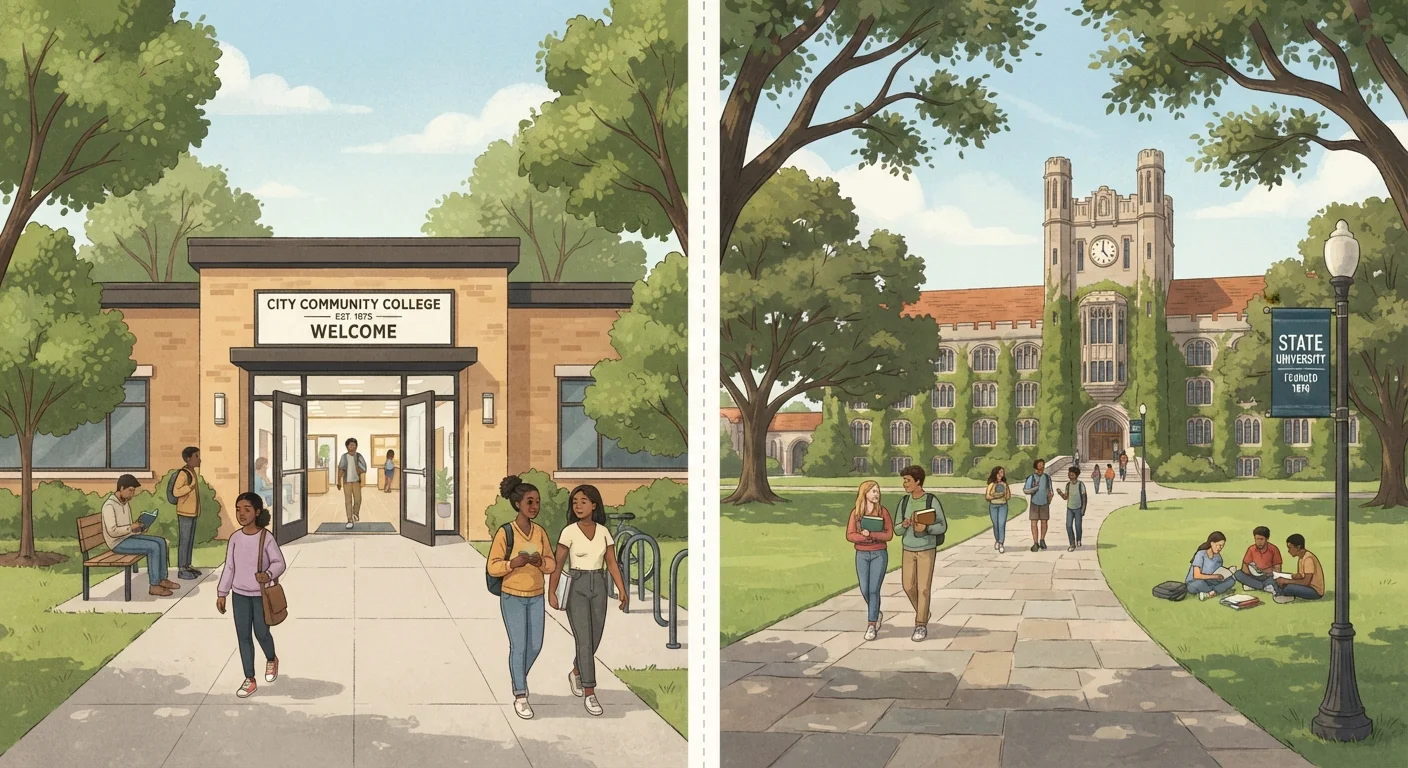
Community colleges are publicly funded two-year institutions that offer associate degrees and certificates across a wide range of fields - from nursing and business to computer science and liberal arts. Tuition is typically much lower than at four-year universities, and financial aid (including federal Pell Grants) is widely available.
What sets community college apart from the other two paths is flexibility and breadth. You can complete a career-ready associate degree, earn a vocational certificate, or use your credits as a lower-cost on-ramp to a four-year university through articulation agreements - formal arrangements that guarantee credit transfer to specific four-year schools. For more on that process, see how community college transfer works.
Community college is a strong fit if you want academic options, aren't yet certain about a single career, or need to balance school with work or family. It's a less direct route to a specific skilled trade than an apprenticeship or vocational program, but it offers more room to pivot.
| Apprenticeship | Trade/Vocational Program | Community College | |
|---|---|---|---|
| Who runs it | Employer or union sponsor | Trade school or vocational institution | Publicly funded two-year college |
| Typical duration | 1-5 years | Weeks to 2 years | 2 years for associate degree |
| Cost to student | Little to none; often paid | Tuition required; varies widely | Low tuition; financial aid available |
| Credential earned | Certificate of completion / journeyperson card | Certificate or diploma | Associate degree or certificate |
| Earning during training | Yes - wages from day one | Generally no | Generally no |
| Transfer to 4-year college | Rare | Limited | Common via articulation agreements |
| How you enter | Apply through employer, union, or DOL-registered program | Enroll at school; some require prerequisites | Apply to the college; open enrollment common |
| Learning format | On-the-job + related instruction | Classroom and lab-based | Classroom, lab, and sometimes online |
Check Registration Before You Enroll
For apprenticeships, look for programs registered with the U.S. Department of Labor or a State Apprenticeship Agency - registration signals quality standards and legal wage protections. For trade schools, verify accreditation through a recognized accrediting body before paying any tuition. For community colleges, confirm that your intended credits transfer if a four-year degree is on your horizon.
How to Choose: Match the Path to Your Situation
There's no universally superior option here - the right choice depends on a few key questions:
- Do you learn best by doing? Apprenticeships put you in the field immediately. Vocational programs offer lab work but in a school setting. Community college is more classroom-oriented.
- Do you need income during training? Only apprenticeships pay you from the start. The other two require you to fund yourself through savings, aid, or part-time work.
- How fast do you want to start working? Some vocational certificates take under a year. Apprenticeships can last up to five years. Community college associate degrees typically take two.
- Do you want transfer options? Community college is the clearest path if you might want a four-year degree later. Apprenticeship and trade credentials rarely transfer to academic credit.
For a balanced look at what vocational routes gain and give up compared to other paths, read our guide to the vocational trade-offs. And if you want to explore which specific skilled trades these paths lead to, see our reference on skilled trades that don't require a four-year degree.