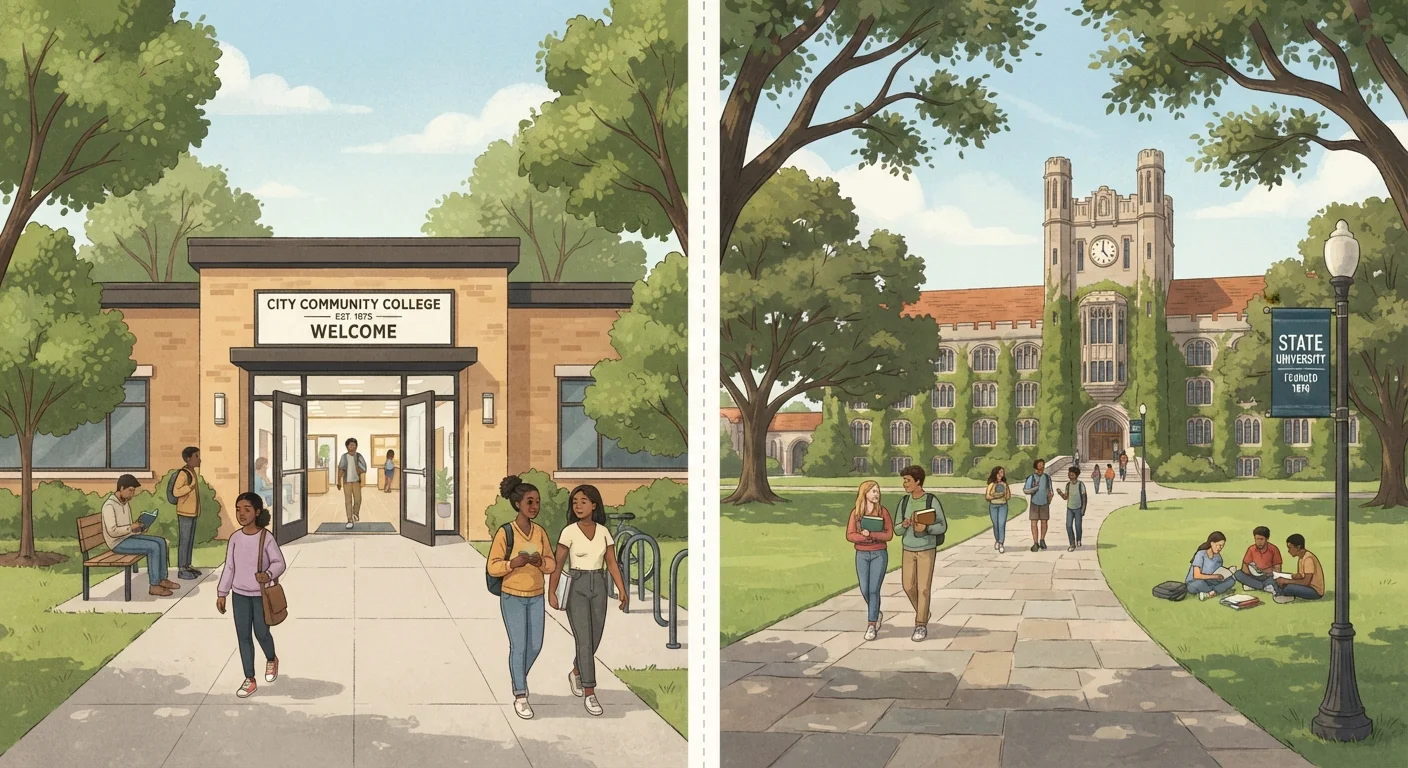


How the Transfer Pathway Actually Works
Transferring from a community college to a four-year university is a well-established, intentionally designed pathway - not a workaround. Millions of students use it to earn a bachelor's degree at a significantly lower total cost by completing their first two years of college-level coursework at a community college before moving to a university for the final two. For a broader look at why students choose this route in the first place, see our community college vs. four-year university comparison.
The core mechanic is credit transfer: courses you complete at your community college are evaluated by the receiving university and - if they qualify - counted toward your degree requirements there. How reliably this happens depends on whether an articulation agreement exists between your two schools. Without one, credit acceptance is evaluated case by case, which introduces uncertainty. With one, both sides have already agreed in writing which courses count and how.
Use Your College's Transfer Center
Most community colleges have a dedicated transfer center staffed by advisors who know exactly which courses satisfy requirements at partner universities. Schedule an appointment in your first semester - this one meeting can save you from taking the wrong courses for an entire year.
First-generation students navigating this process for the first time will find additional context in our guide on navigating higher education as a first-generation student, which covers financial aid basics and building a support network.
What to Do - Step by Step
What you will need
State Transfer Guide or Common Course Numbering System
Shows which community college courses are pre-approved equivalents at public universities in your state.
FAFSA (Free Application for Federal Student Aid)
Required to access federal grants, loans, and work-study funds at the four-year school after transfer.
College Transfer Center or Counseling Office
Provides personalized advising, articulation agreement access, and application support.
Target School's Transfer Admission Portal
Where you submit your formal transfer application, transcripts, and supporting documents.
Identify your transfer goal early
Decide, at least in general terms, what you want to study and what type of four-year school interests you - public university, private college, in-state or out-of-state. You do not need a perfect answer right away, but a working direction lets your advisor point you toward the right coursework. If you are still weighing a four-year degree against other routes, our overview of community college vs. four-year university lays out the key trade-offs.
Meet with a transfer counselor
Book an appointment with your community college's transfer counselor or academic advisor - ideally within your first month of enrollment. Bring your list of target schools. The counselor can pull up articulation agreements (formal course-equivalency maps between your college and four-year partners), identify any guaranteed admission programs in your state, and help you build a semester-by-semester plan.
Understand articulation agreements
An articulation agreement is a formal contract between your community college and a specific four-year school that pre-approves certain courses for transfer credit. When you complete a course listed in the agreement, that credit is recognized at the receiving institution - typically with a defined equivalent course. Many states publish statewide transfer guides or common course numbering systems online. Look up agreements for each school on your list and download the relevant course equivalency tables.
Build a transfer-ready course plan
Using the articulation agreement and your counselor's guidance, map out which courses to take each semester. Prioritize: (1) general education requirements that transfer broadly, (2) lower-division prerequisites for your intended major, and (3) electives that fit within your target school's credit cap. Avoid accumulating excess credits - most four-year schools accept a maximum of 60-70 semester hours from a two-year college.
Maintain the GPA required for admission
Transfer admission is largely GPA-driven. The minimum for most public universities is around 2.0, but selective programs - nursing, engineering, business, and many others - commonly require a 3.0 or higher. Check the specific GPA requirement for each program on your list, not just the university's general minimum. If your GPA dips in a difficult semester, seek tutoring or academic support services before the semester ends rather than after grades are posted.
Gather and submit your transfer application
Most four-year universities have a separate transfer application portal. You will typically need: official transcripts from all colleges attended, a personal statement or transfer essay, letters of recommendation (varies by school), and proof of financial aid eligibility (FAFSA or state equivalent). Deadlines for fall transfer admission often fall between November and March of the preceding year - check each school's specific dates. Submit your FAFSA as early as possible to maximize aid eligibility.
Evaluate your offer and confirm credit acceptance
When you receive an admission offer, request a formal credit evaluation - a document showing exactly which of your community college credits will apply toward your degree at that school. Review it carefully against your expectations. If courses you expected to transfer are denied, ask the department chair or registrar for an appeal process. Once satisfied, confirm your enrollment, notify your community college of your departure date, and arrange housing, financial aid disbursement, and orientation.
Not All Credits Transfer Automatically
Even with an articulation agreement in place, individual courses may not transfer if they fall outside your intended major or the agreement's scope. Always get a written credit evaluation from your target school before assuming a course will count. Verbal assurances are not binding.
Watch Your Credit Hour Limit
Many four-year universities cap the number of community college credits they will accept - commonly 60-70 semester hours. Taking more credits than the cap before transferring can mean paying for coursework that does not count toward your degree. Track your total hours each semester.
Common Pitfalls and How to Avoid Them
The most frequent mistake transfer students make is waiting too long to plan. Students who start thinking about transfer in their second year often discover they took courses that do not satisfy the requirements of their target program - meaning extra semesters and extra cost. Starting the conversation in semester one, even if your plans feel uncertain, keeps every option open.
A second common issue is assuming all credits will transfer simply because they were earned at an accredited college. Accreditation is necessary but not sufficient - course content, level, and relevance to your major all factor into a receiving school's decision. Always request a written credit pre-evaluation before you enroll if a school offers one.
Finally, watch your total credit count. Accumulating more than 60-70 semester hours before transferring can leave you paying for coursework the four-year school simply will not count. If you are close to that cap, prioritize applying over taking additional courses. For more questions to ask yourself before committing to any school or program, our guide on questions to ask before committing to a college is a practical next step.