

What Each Path Actually Involves
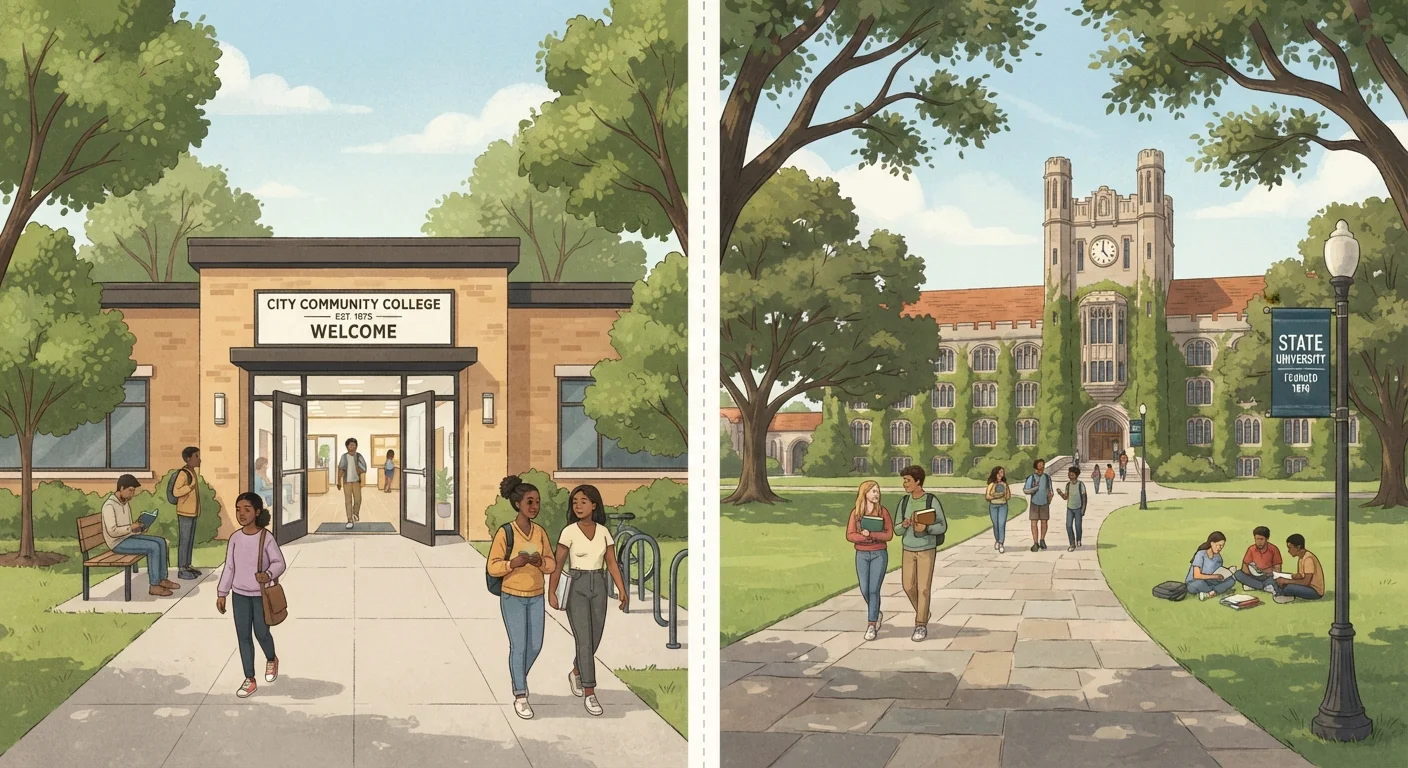
Community colleges (also called two-year colleges or junior colleges) are publicly funded institutions that award associate degrees - typically the Associate of Arts (A.A.) or Associate of Science (A.S.) - and certificates in specific career fields. Most programs are designed to be completed in two years of full-time study, though many students take longer while working.
Four-year universities award bachelor's degrees - the Bachelor of Arts (B.A.) or Bachelor of Science (B.S.) - after roughly four years of full-time enrollment. They range from large public research institutions to smaller private colleges. For a broader map of how these institutions fit into U.S. higher education, see The U.S. Higher Education System, Mapped Out.
Both types of school are regionally accredited, meaning credits earned at one can - under the right conditions - transfer to the other. Accreditation is the baseline quality signal you should always check before enrolling anywhere.
Cost and Financial Aid: The Numbers That Matter Most
Tuition is the sharpest difference between the two paths. According to the College Board's annual Trends in College Pricing report, average published tuition and fees at public two-year colleges run significantly lower than at public four-year institutions - and the gap widens further at private universities.
~$3,900
Average annual tuition at public 2-year colleges
According to the College Board's Trends in College Pricing report, public two-year college tuition is substantially below public four-year in-state rates.
~$11,260
Average in-state tuition at public 4-year universities
College Board data shows public four-year in-state tuition averages roughly three times the community college rate before room, board, and fees.
~1 in 3
Share of U.S. undergraduates enrolled at community colleges
The American Association of Community Colleges reports that community colleges enroll approximately one-third of all undergraduate students in the United States.
It's important to distinguish published (sticker) price from net price - what you actually pay after grants and scholarships. Both community colleges and universities participate in federal financial aid programs, including Pell Grants, which are awarded based on financial need and do not need to be repaid. Students at either institution type can complete the FAFSA (Free Application for Federal Student Aid) to determine eligibility.
One cost often overlooked: if you start at a community college and successfully transfer, your total four-year credential cost can be considerably lower than enrolling at a university from day one - even if the university's net price seems reasonable. Debt accumulated early in a degree has more time to grow, which matters when thinking about long-term financial health. For a broader look at managing education-related debt, the Credit & Debt hub is a useful starting point.
Transfer: The Bridge Between the Two Paths
One of the most important things to understand is that starting at a community college does not mean you can't earn a bachelor's degree. Many students use community college as a deliberate first step.
The mechanism that makes this work is called an articulation agreement - a formal arrangement between a community college and a university that guarantees credit transfer and, in some cases, guaranteed admission once you meet certain requirements. California's ASSIST system and similar state-level frameworks in Florida, Texas, and elsewhere have made transfer pathways significantly more structured over the past decade.
That said, transfer isn't automatic. Credits don't always map cleanly from one institution to another, and not every community college has agreements with every university. Our detailed guide on transferring from community college to a four-year school explains how articulation agreements work and what to do in your first year to protect your options.
Protect Your Transfer Credits From Day One
If you plan to transfer, meet with a counselor in your first semester - not your last. Ask specifically which courses fulfill requirements at your target university, and get that guidance in writing where possible. Taking courses that won't transfer is one of the most common and costly mistakes community college transfer students make.
Side-by-Side: Key Differences at a Glance
The table below summarises the most practical differences across the criteria that tend to matter most to incoming students. Remember that specific numbers vary by state, institution, and individual financial aid package.
| Criterion | Community College | Four-Year University |
|---|---|---|
| Typical degree awarded | Associate degree or certificate | Bachelor's degree |
| Program length (full-time) | 2 years | 4 years |
| Average annual tuition (public) | ~$3,900 (2-year public) | ~$11,260 (4-year public, in-state) |
| Schedule flexibility | High - evening, weekend, online | Moderate - primarily daytime |
| Campus residential life | Rare; mostly commuter campuses | Common; dorms and campus culture |
| Class sizes | Generally smaller | Varies; large lecture halls common |
| Path to bachelor's degree | Via transfer (2+2 model) | Direct enrollment |
| Admission selectivity | Open access (most schools) | Competitive to highly selective |
If you're also weighing options beyond college entirely, Four-Year Degree vs. Vocational Training and the Trade & Vocational hub cover how skilled-trades routes compare on cost, duration, and earning potential.
How to Choose: Questions Worth Asking Yourself
No formula produces the right answer for every person, but a few honest questions can narrow it down significantly:
- Do I know what I want to study? If not, lower-cost exploration at a community college is a reasonable hedge.
- What's my realistic financial picture? Factor in living costs, not just tuition. Commuting from home while attending a community college cuts costs further.
- Does my target career require a bachelor's degree from a specific type of school? Some employers and graduate programs look at institutional reputation; many do not.
- Am I ready for the pace and structure of a four-year campus? Community colleges often have stronger academic support for students who need to rebuild study habits.
Before you commit to anything, our article on questions to ask before committing to a college or program walks through exactly what to investigate - from graduation rates and transfer policies to financial aid timelines.
This article provides general educational information only. Tuition figures, financial aid eligibility, and transfer policies vary by institution and change over time. Always verify current details directly with the institutions you are considering.