
Why the Map Matters
If you're the first in your family to consider college - or you're simply not sure where to start - the U.S. higher education system can feel overwhelming. Terms like associate degree, liberal arts college, and vocational certificate get thrown around without explanation, and the sheer number of options makes it hard to know which path is even meant for you.
This guide breaks the system into its core institution types, explains what each one is designed to do, and helps you see how the pieces fit together. For a deeper look at the language used across all of these settings, see our higher education glossary for plain-English definitions of key terms.
~40%
U.S. undergraduates enrolled at community colleges
According to the American Association of Community Colleges, community colleges enroll roughly 40% of all U.S. undergraduates, making them the most common entry point into higher education.
2-4x
Cost difference between community college and four-year university
The College Board's annual Trends in College Pricing report consistently shows that average tuition and fees at public two-year colleges are a fraction of those at public four-year institutions.
~30 million
Adults with some college but no degree
The National Student Clearinghouse estimates roughly 30 million U.S. adults started college but did not complete a credential - highlighting how important it is to choose an institution and program that fits your realistic circumstances.
The Main Institution Types
Community Colleges
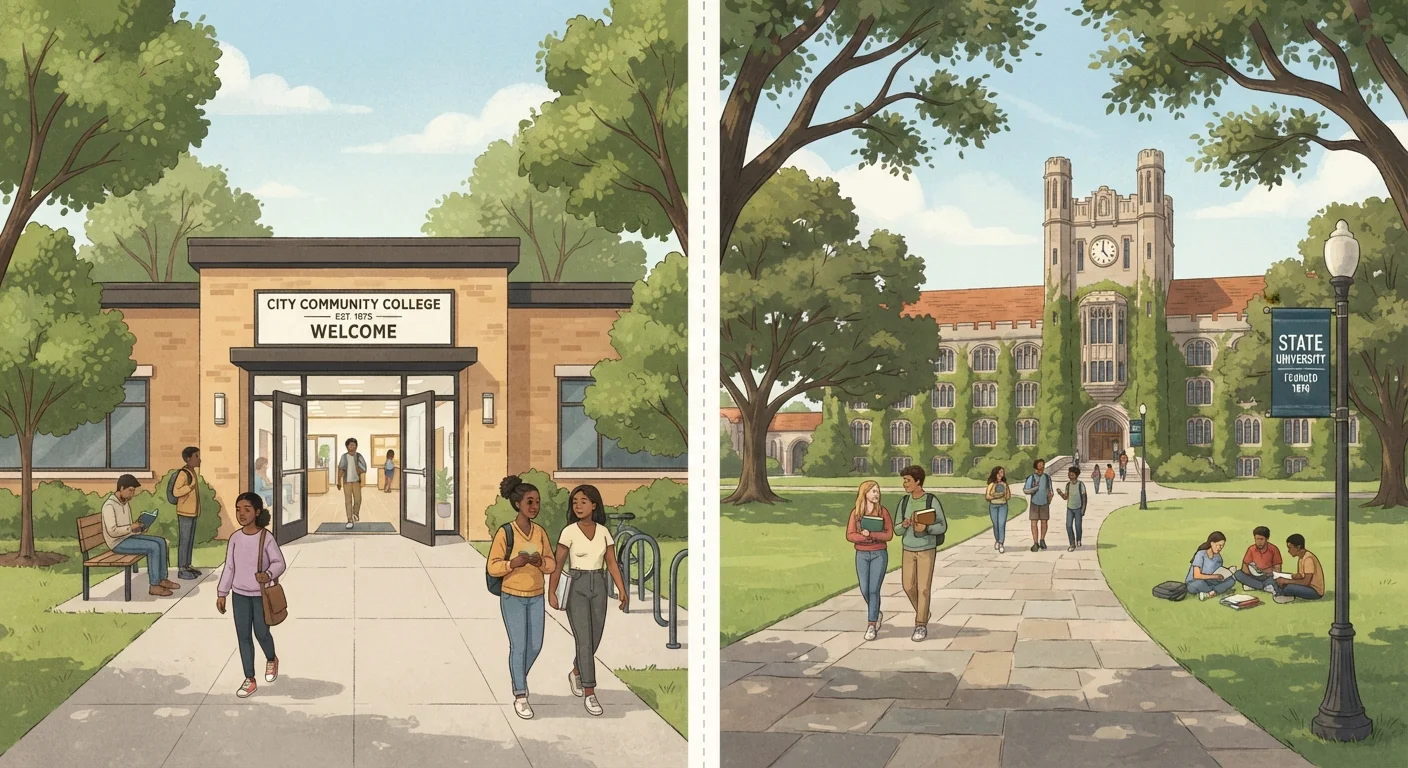
Community colleges are two-year public institutions that offer associate degrees and certificates. They are typically the most affordable entry point into higher education and serve a wide range of students - recent high school graduates, working adults, and those looking to retrain for a new career. Many students use community college as a stepping stone, completing two years of general coursework before transferring to a four-year university. For a detailed comparison of costs and outcomes, see our article on community college vs. four-year university.
Four-Year Colleges and Universities
These institutions award bachelor's degrees - the most commonly referenced credential in the U.S. job market. A bachelor's typically takes four years of full-time study. Universities also offer graduate programs (master's and doctoral degrees) for students who continue beyond their undergraduate work. Four-year schools range from large public research universities to small private liberal arts colleges; each has a different culture, focus, and price tag.
Trade and Vocational Schools
Trade schools - also called vocational or career schools - focus on training students for a specific skilled occupation. Programs typically run from several months to two years and result in a certificate or diploma. Common fields include electrical work, plumbing, welding, medical assisting, and cosmetology. If you're interested in this route, our hub on trade and vocational programs is a solid starting point. You can also explore how trade programs compare to apprenticeships in our article on apprenticeships, trade programs, and community college.
Start with the Credential, Not the Campus
Before you fall in love with a school's campus or reputation, research what credential your target career actually requires. Knowing whether you need a certificate, associate degree, or bachelor's degree first narrows your institution choices significantly - and helps you avoid overpaying for more education than the role demands.
What Accreditation Means - and Why It's Non-Negotiable
Accreditation is an independent review process that determines whether an institution meets established educational standards. In the U.S., regional accreditation is the most respected form - credits from regionally accredited schools transfer most reliably, and employers are more likely to recognize these credentials. Before enrolling anywhere, verify the school's accreditation status through the U.S. Department of Education's database.
Regional vs. National Accreditation
Regional accreditation is generally considered the higher standard in the U.S. and is held by most community colleges, public universities, and traditional private institutions. National accreditation is more common among trade schools and for-profit colleges, but credits from nationally accredited schools may not transfer to regionally accredited institutions. Always ask about transfer policies if you plan to continue your education.
For-profit institutions require particular scrutiny. Some have faced legal action over misleading enrollment practices. Checking accreditation and researching graduation and job placement rates is especially important when evaluating any for-profit school.
Choosing the Right Starting Point
There is no universally correct path. The right institution depends on your career goals, finances, timeline, and learning preferences. A few guiding questions can help narrow things down:
- What credential does your target career actually require? Some fields demand a bachelor's degree; others hire directly from certificate or associate programs.
- What can you realistically afford? Federal financial aid - including Pell Grants - is available at accredited community colleges and many trade schools, not just four-year universities. Completing the FAFSA opens doors at all institution types.
- How much time do you have? A two-year program or certificate may get you into the workforce faster if that matters more right now.
If you're still weighing your options, our guide on questions to ask before committing to a program walks through the key factors to investigate before you enroll. First-generation students will also find tailored guidance in our article on navigating higher education as a first-generation student.