

Why First-Generation Students Inherit More Myths Than Maps
When no one in your family has been to college, most of what you know about higher education comes secondhand - from neighbors, social media, or well-meaning relatives who attended decades ago. That gap creates fertile ground for myths that feel like facts. Some of these misconceptions stop students from applying at all. Others push them toward choices that don't fit their actual goals or finances.
This article tackles the most common myths head-on, with clear corrections. If you want a broader vocabulary for navigating higher education, our Higher Education Jargon, Decoded glossary is a useful companion read.
Myth
You need to know your major before you apply - colleges want to see a clear plan.
Fact
Most colleges allow students to apply as undecided, and many actively encourage it for first-year students.
Declaring a major on an application is optional at the vast majority of four-year colleges. Admissions offices understand that 17- and 18-year-olds are still figuring out their interests. Applying as undecided does not hurt your chances, and many schools have first-year exploratory programs designed specifically for students who haven't settled on a direction. The pressure to have a five-year plan before you even enroll is a myth that mostly benefits no one.
Myth
Private colleges are always too expensive - only rich students go there.
Fact
Private colleges often award larger institutional grants, meaning the actual out-of-pocket cost can be lower than at a public school.
Sticker price and net price are two very different numbers. A private university might list tuition at $55,000 a year, but if it awards a $35,000 institutional grant to a student who qualifies based on financial need, the student's actual bill is $20,000 - potentially less than an in-state public university after accounting for all fees. The only way to compare true costs is to apply, receive a financial aid offer, and compare net prices side by side. Never rule out a private school solely based on its published tuition.
Myth
Financial aid is only for students with top grades.
Fact
Need-based financial aid - the largest category - is determined by family finances, not GPA.
The FAFSA (Free Application for Federal Student Aid) calculates your eligibility for federal grants, loans, and work-study based on household income and assets, not academic performance. Merit scholarships do reward grades, but they represent a smaller share of overall aid. Many first-generation students who assume they won't qualify never file the FAFSA and leave significant grant money unclaimed. Submitting the FAFSA - even if you're unsure - costs nothing and opens the door to every category of federal aid.
Myth
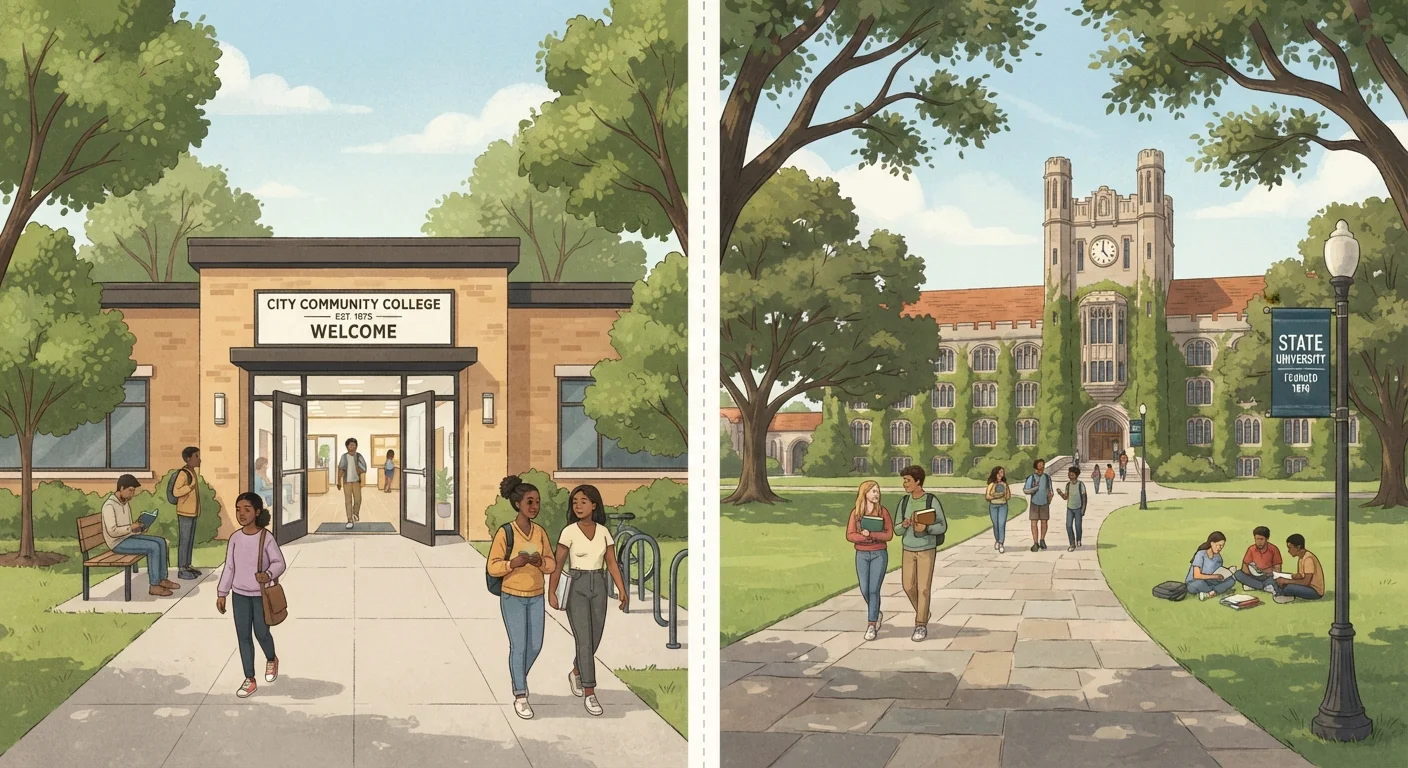
Community college is a backup plan for students who couldn't get in anywhere else.
Fact
Community college is a deliberate, cost-effective pathway that feeds into four-year programs through formal transfer agreements.
Many students choose community college strategically: lower tuition for general education requirements, the ability to work while studying, and articulation agreements (formal contracts between institutions) that guarantee credit transfer to a four-year university. Some state systems have articulation agreements that, if followed correctly, guarantee admission to a four-year campus upon completion of an associate degree. That's a structured route, not a fallback. Hidden program differences are worth understanding before you commit - see Degree Paths That Catch Students Off Guard for what to watch for.
Myth
You need a parent or family member who went to college to navigate the process.
Fact
First-generation students have access to dedicated federal programs, college support offices, and peer networks built specifically for them.
Federal TRIO programs - including Upward Bound, Student Support Services, and McNair Scholars - exist by law to support first-generation and low-income students through every stage of the college journey. Most four-year colleges also have dedicated first-generation student centers or advisors. Not having a college-educated parent is not a disadvantage the system ignores; it is a category the system formally recognizes and funds support for. You are not starting from scratch - you are starting from a recognized starting point with institutional resources behind you.
What the Evidence Actually Shows
Behind each myth is usually a kernel of a real concern - cost, uncertainty, academic pressure - that deserves a straight answer rather than dismissal. The stats below give that context.
56%
Of undergraduates receive some form of financial aid
According to the National Center for Education Statistics, more than half of all undergraduate students in the U.S. receive financial aid in the form of grants, loans, or work-study.
~1 in 3
College students are first-generation
Research from the Pell Institute and other higher education researchers consistently finds that roughly one-third of U.S. undergraduates are the first in their families to pursue a four-year degree.
Over 900
Colleges with formal transfer articulation agreements
Hundreds of community colleges maintain articulation agreements with four-year institutions, creating structured pathways that protect students' academic credits when transferring.
Understanding these numbers matters before you make any decision. For a structured way to evaluate specific schools, see Questions to Ask Before Committing to a College or Program, which walks through graduation rates, financial aid timelines, and transfer policies.
Don't Skip the FAFSA Based on Assumptions
Many students - especially those from families with moderate incomes - assume they earn too much to qualify for aid and never file. This is one of the costliest mistakes in college planning. Federal grant eligibility thresholds, loan access, and many institutional grants all require a FAFSA on file. Filing takes less than an hour and has no downside. Do it regardless of what you expect the outcome to be.
If you're still working out what you want to study, Choosing a College Major When You Have No Idea What You Want offers practical, pressure-free approaches. And if you're curious how public and private institutions compare beyond sticker price, Public vs. Private Universities: What the Difference Actually Means for You breaks down tuition structures, class sizes, and culture. Once you're ready to move forward, Navigating Higher Education as a First-Generation College Student provides a full starting-point guide built specifically for students in your position.
This article is for general informational and educational purposes only. Financial aid eligibility, tuition costs, and program structures vary by institution and individual circumstance. Always verify details directly with the colleges and financial aid offices you are considering.