

Why Degree Levels Matter Before You Enroll
Most students pick a college based on name recognition or location, but the degree level they pursue is often the bigger decision. Each level signals a different depth of training to employers, carries a different price tag, and takes a different amount of time to complete. Before you commit to anything, it helps to see the full map.
If terms like "credit hours," "accreditation," or "articulation agreement" already feel unfamiliar, bookmark our Higher Education Jargon, Decoded - it pairs well with this reference.
| Associate Degree Length | ~2 years (60-65 credit hours) |
| Bachelor's Degree Length | ~4 years (120 credit hours) |
| Master's Degree Length | 1-2 years beyond bachelor's |
| Professional Degree Length | 3-4 years beyond bachelor's |
| PhD Length | 4-7 years (varies by field) |
| Median weekly earnings (bachelor's vs. high school diploma) | ~65% higher for bachelor's holders (U.S. Bureau of Labor Statistics, Employment Situation of Veterans) |
The Five Core Degree Levels
Associate Degree
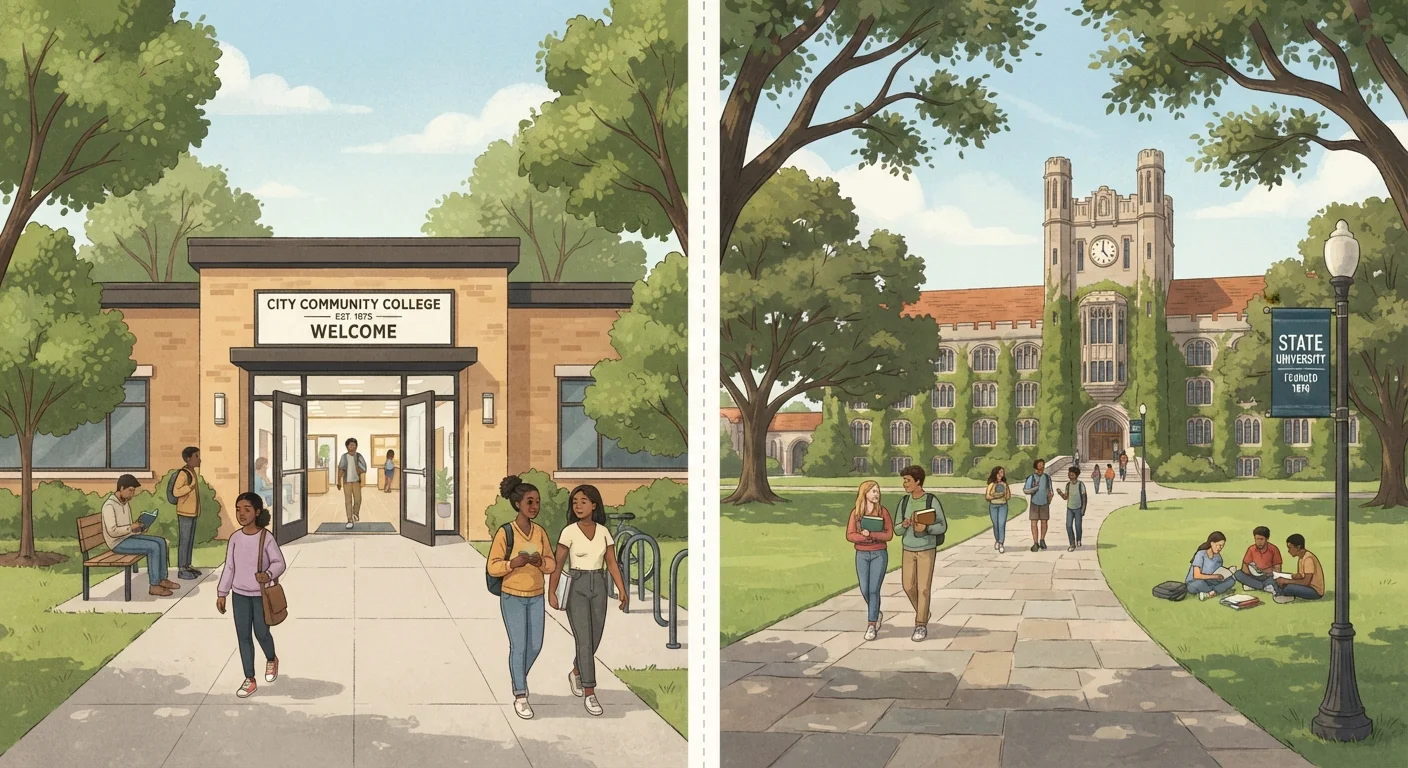
Typical length: 2 years (60-65 credit hours). Offered primarily at community colleges and some technical schools. An associate degree can serve as a standalone credential in fields like nursing (ADN), business, or IT - or as a stepping stone toward a bachelor's degree through a transfer or articulation agreement. Cost is substantially lower than a four-year institution, making it a common first move for students who are budget-conscious or still exploring a direction.
Bachelor's Degree
Typical length: 4 years (120 credit hours). The most widely recognized credential in the U.S. labor market. Bachelor's programs combine general education requirements with a major area of study. A BA typically emphasizes humanities and social sciences; a BS leans toward quantitative or scientific disciplines. Many professional jobs list a bachelor's as a minimum requirement.
Master's Degree
Typical length: 1-2 years beyond a bachelor's. A master's signals focused expertise in a field - common examples include an MBA, MSW, or MEd. Some programs are professionally oriented (designed to advance a career); others are research-oriented (designed to prepare for doctoral study). Many master's programs require a thesis or capstone project.
Professional Degree
Typical length: 3-4 years after a bachelor's. Professional degrees - such as a JD (law), MD (medicine), or PharmD (pharmacy) - are practice-focused credentials that license you to work in a regulated profession. They are distinct from academic doctorates. Entry into these programs is typically highly competitive and involves dedicated admissions exams.
Doctoral Degree (PhD)
Typical length: 4-7 years after a bachelor's, though timelines vary significantly. A PhD is the highest academic credential in most fields. It centers on original research and culminates in a dissertation. PhDs are pursued by those aiming for academic careers, senior research roles, or fields where advanced expertise is expected. Funding through assistantships or fellowships is common but not guaranteed.
Associate Degree
A two-year undergraduate credential typically earned at a community college. It can lead directly to employment or transfer toward a bachelor's degree.
Bachelor's Degree
A four-year undergraduate degree that combines a major field of study with general education requirements. It is the baseline credential for many professional careers.
Master's Degree
A graduate-level degree earned after a bachelor's, usually in 1-2 years. It signals advanced knowledge in a specific field and may be professionally or research focused.
Professional Degree
A practice-focused graduate credential (such as a JD or MD) that prepares graduates to work in a licensed profession. Distinct from an academic doctorate.
Doctorate (PhD)
The highest academic credential, centered on original research and a dissertation. Typically takes 4-7 years after a bachelor's degree.
Credit Hour
The unit used to measure coursework. One credit hour generally represents one hour of classroom instruction per week over a semester, plus additional study time.
Articulation Agreement
A formal arrangement between two institutions - typically a community college and a four-year university - guaranteeing that specific credits will transfer toward a bachelor's degree.
Credentials That Sit Alongside Degrees
Not every valuable credential is a degree. Certificates, micro-credentials, and professional certifications can complement degree pathways or stand on their own - particularly in technology, trades, and healthcare. These are worth understanding separately. Our guide on what certificates, credentials, and degrees actually mean breaks down the distinctions clearly.
If a four-year degree doesn't feel like the right fit at all, it's also worth comparing paths directly. See how a degree and vocational training compare on cost and earnings before deciding.
Degree Level vs. Field of Study Are Separate Decisions
Choosing a degree level (associate, bachelor's, master's) and choosing a field of study (nursing, business, engineering) are two different choices that happen to overlap. You can hold an associate degree in nursing or a doctoral degree in nursing - the level shapes your scope of practice and career ceiling, but the field shapes your day-to-day work. Think through both independently before committing to a program.
One thing many students discover too late: the path through a degree isn't always straightforward. Prerequisites, program sequencing, and time-to-graduation gaps catch people off guard. Our article on degree paths that catch students off guard covers what to watch for before you enroll.