

Why the Labels Matter More Than You Think
The online education market has grown enormously, and so has the vocabulary that comes with it. Terms like certificate, credential, micro-credential, certification, and degree appear across course platforms, university websites, and job postings - often used interchangeably, even though they mean very different things.
Choosing the wrong credential type isn't just an academic inconvenience. It can mean spending money on a qualification that doesn't meet your employer's requirements, or crediting yourself with skills that a hiring manager categorizes differently. Getting clear on these labels up front is one of the most practical steps you can take. For a broader foundation, see our complete guide to online learning before committing to any program.
Certificates: Proof of Completion
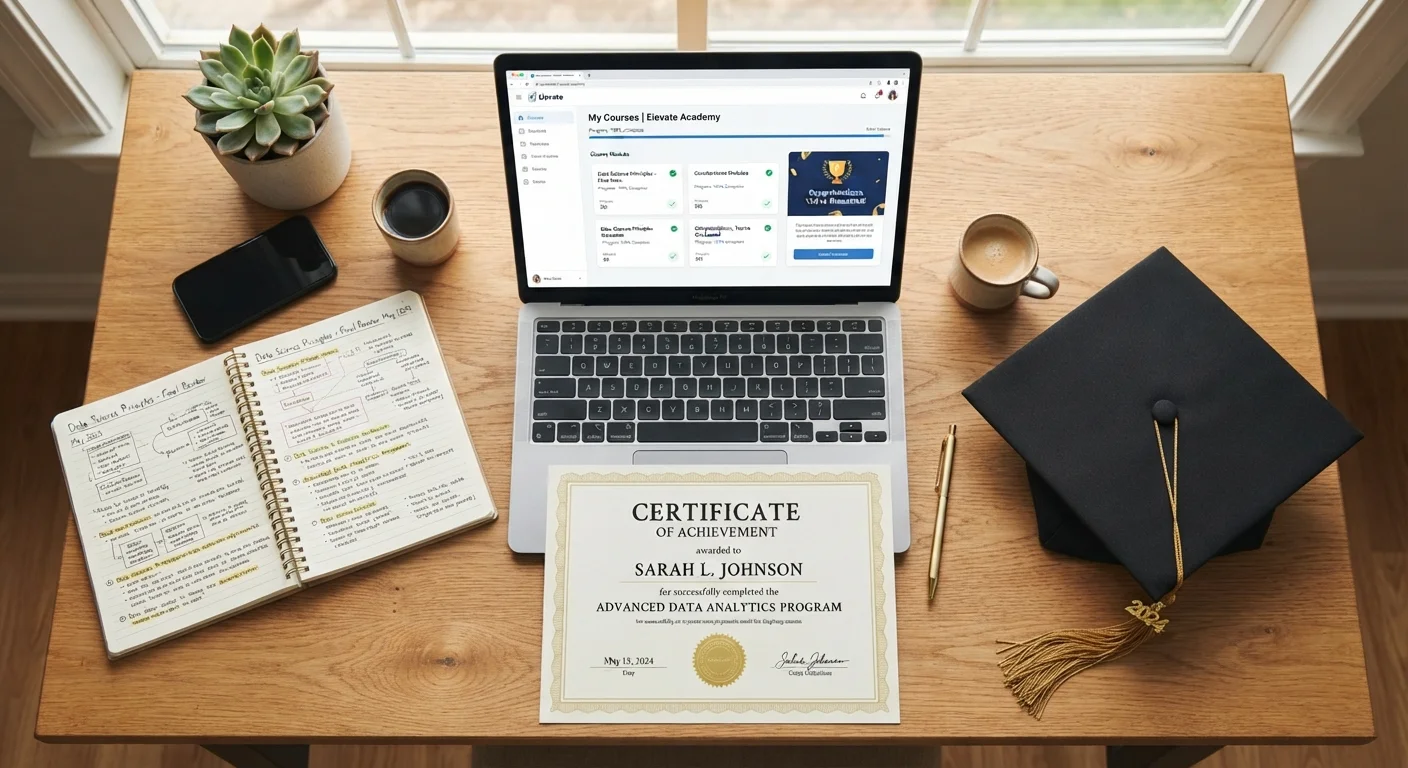
A certificate is issued by a school, college, or online platform when you finish a defined course or program. It documents that you showed up, completed the work, and met the provider's requirements. Certificates range from a weekend workshop to a multi-month vocational program.
The weight a certificate carries depends almost entirely on who issued it. A certificate from an accredited community college in medical billing carries very different credibility than one from a small, unverified online platform. Platform-based certificates from widely recognized providers can still be valuable for demonstrating initiative and specific skill sets, particularly in technology and creative fields - but they generally do not replace academic credentials in hiring decisions that require a degree.
Check Before You Enroll
Always confirm a program's accreditation status through the U.S. Department of Education's database or the CHEA (Council for Higher Education Accreditation) before paying tuition or committing significant time. A quick search takes minutes and can protect you from investing in a credential that employers or transfer institutions won't recognize.
For a plain-language breakdown of every formal degree level - from associate to doctorate - see our guide to every type of college degree.
Certifications: Proof of Competency
A certification is fundamentally different from a certificate. Rather than documenting course completion, a certification proves you passed a standardized assessment - usually administered by an independent professional or industry organization. Examples include the Project Management Professional (PMP) exam or CompTIA's IT certifications.
Because certifications are tied to external, third-party standards, they often carry significant weight with employers in fields where those standards are widely recognized. Many certifications also expire, requiring ongoing professional development to maintain - a feature that signals continued competency rather than one-time achievement.
7.3M+
U.S. students enrolled in online courses
According to the National Center for Education Statistics, millions of students participate in some form of distance education each academic year.
62%
Employers who view online degrees as equal to on-campus degrees
A Society for Human Resource Management survey found a majority of HR professionals consider accredited online degrees on par with traditional ones.
30%+
Growth in professional certification demand
Industry reports indicate growing employer preference for role-specific certifications, particularly in technology, project management, and healthcare fields.
Online Degrees: Accreditation Is Everything
An online degree - whether an associate, bachelor's, master's, or doctorate - earned from an accredited institution carries the same academic standing as an equivalent degree earned on campus at the same school. The format of delivery does not diminish the credential when the institution holds legitimate accreditation.
Accreditation is the single most important factor to evaluate. Regional accreditation (granted by bodies recognized by the U.S. Department of Education) is the most widely respected standard for academic credentials. National accreditation is common among trade and vocational schools and carries different implications for credit transfer and employer recognition. An unaccredited degree is a serious risk - many employers and graduate schools will not recognize it. Before enrolling anywhere, use the guide to verifying online accreditation to confirm a program's standing.
Regional vs. National Accreditation
Regional accreditation is generally the gold standard for academic degrees and is required by most universities for credit transfer. National accreditation is more common among trade and vocational schools and may not be accepted for credit transfer by regionally accredited institutions. If you plan to continue to graduate school or transfer credits, regional accreditation matters significantly.
Micro-Credentials: The Middle Ground
Micro-credentials are short, focused qualifications that target specific, demonstrable skills rather than broad subject mastery. They sit somewhere between a single course completion and a full certificate program. Universities, platforms, and professional organizations all issue them under various names: digital badges, nanodegrees, specializations, or professional certificates.
Their value is still evolving. In some industries - particularly technology, data analysis, and project management - micro-credentials from recognized providers are actively sought by employers. In others, they function better as supplements to formal degrees than as standalone qualifications. Before pursuing one, research how employers in your specific target field view the issuing organization. Our deep dive on micro-credentials walks through how to evaluate them strategically.
How to Choose the Right Credential for Your Goal
The right credential type depends on three things: your immediate goal, your industry, and how much time and money you can invest. If you need to enter a specific regulated field - nursing, teaching, accounting - a formal accredited degree is likely non-negotiable. If you're upskilling for a current role or pivoting into a new technical area, a recognized certification or targeted micro-credential may deliver faster returns.
Questions worth asking before enrolling in any online program:
- Is the issuing institution or organization accredited by a recognized body?
- Do employers in your target field specifically recognize this credential?
- Will credits count toward a future degree if you decide to pursue one?
- Is the cost proportionate to the likely career benefit?
For context on how free versus paid options stack up, see our comparison of free courses vs. paid certifications. If you're considering college-level credentials, our overview of degree options and pathways is a useful companion. And if education costs are a concern, understanding how financing works - including credit and debt basics - can help you plan responsibly.
This article is for general informational and educational purposes only. It does not constitute academic advising, career counseling, or financial advice. Readers should verify program details directly with institutions and consult qualified advisors for decisions specific to their circumstances.