

What Each Coverage Level Actually Includes
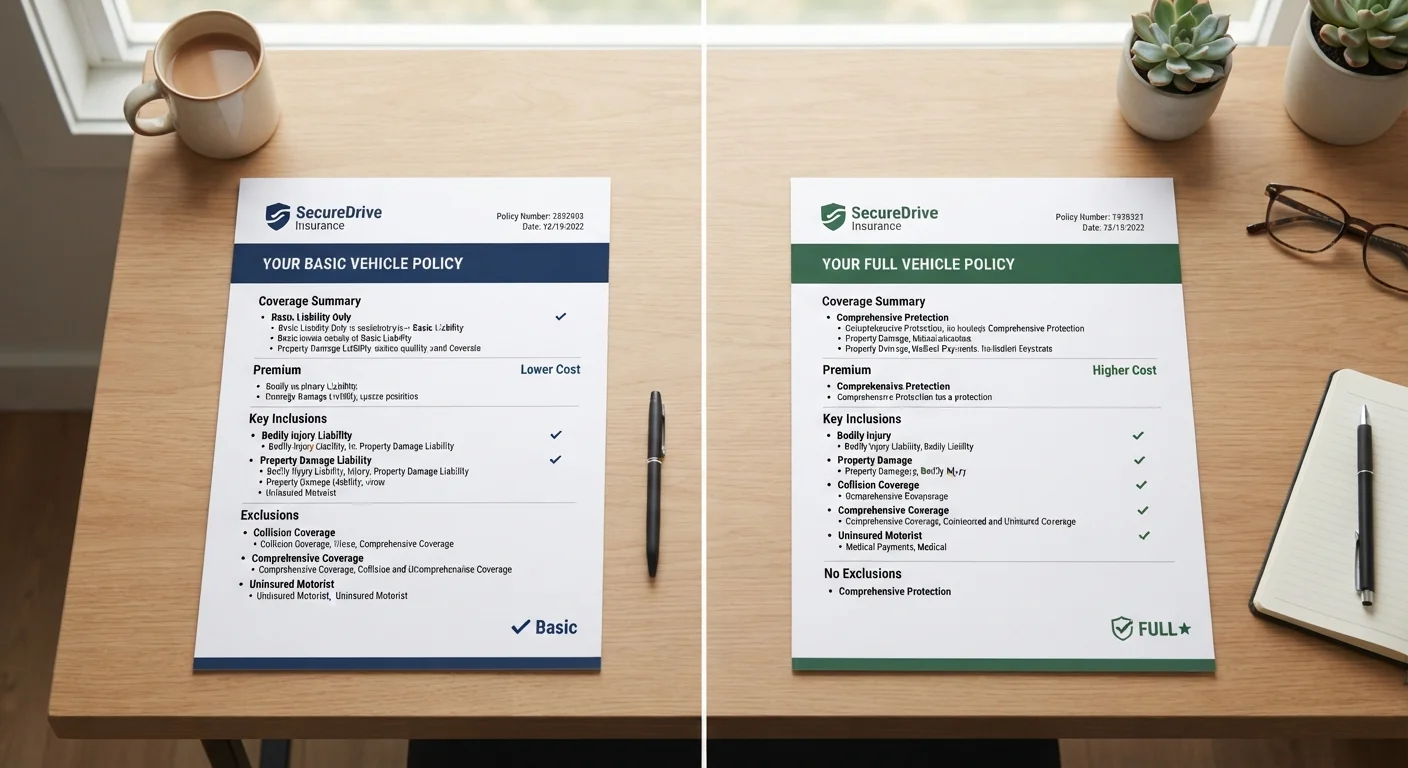
Before comparing cost, it helps to be precise about what you're actually buying. Auto insurance is not a single product - it's a bundle of different protections, and "liability-only" vs. "full coverage" describes which pieces of that bundle you're carrying.
Liability-only means you have the minimum legally required coverage: bodily injury liability and property damage liability. If you cause a collision, these pay for the other driver's medical bills and vehicle repairs. What liability does not cover is any damage to your own car. If you rear-end someone and your car needs $4,000 in repairs, that's entirely on you.
Full coverage is an informal term - no insurer sells a policy literally called that. In practice it refers to a policy that adds collision coverage (pays for your car's damage in an accident, regardless of fault) and comprehensive coverage (pays for non-collision losses like theft, hail, flood, or a fallen tree). Together, these two additions mean your own vehicle is protected, not just the other party's.
For a deeper look at how each coverage type is defined, see what liability, collision, and comprehensive actually cover.
| Criterion | Liability-Only | Full Coverage |
|---|---|---|
| Covers damage you cause to others | Yes | Yes |
| Covers your own car in a collision | No | Yes (collision coverage) |
| Covers theft, weather, or non-collision loss | No | Yes (comprehensive coverage) |
| Meets state legal minimum | Yes | Yes |
| Required for financed/leased vehicles | No - lender requires more | Yes - satisfies lender requirement |
| Monthly premium | Lower | Higher |
| Subject to a deductible on your car | Not applicable | Yes |
| Best suited to | Older, low-value owned vehicles | Newer, financed, or high-value vehicles |
The Financial Logic Behind Each Choice
The core question isn't which coverage is better in the abstract - it's which one makes financial sense for your specific situation. Two numbers drive that decision more than anything else: your car's current market value and the annual cost of adding collision and comprehensive.
A widely cited rule of thumb is that if your annual collision and comprehensive premium exceeds 10% of your car's value, those coverages may not be cost-effective. For example, if your car is worth $3,500 and adding collision and comprehensive costs $600 per year, you're paying a significant share of the car's value annually - and any claim is still subject to your deductible before the insurer pays a cent.
~$700+
Average annual cost of collision and comprehensive coverage
According to the National Association of Insurance Commissioners (NAIC), the combined average expenditure for collision and comprehensive coverage across U.S. policyholders has consistently exceeded several hundred dollars annually, varying by state and driver profile.
10%
Rule-of-thumb threshold for coverage cost vs. car value
Financial planning resources commonly suggest reconsidering collision and comprehensive coverage when annual premiums approach or exceed 10% of the vehicle's current market value.
~80%
Share of U.S. drivers carrying more than liability-only
NAIC data indicates the large majority of insured U.S. drivers carry collision or comprehensive coverage, reflecting both lender requirements and driver preference for broader protection.
That said, this is general financial reasoning, not personalized advice. Your tolerance for financial risk, your savings cushion, and whether you could manage without a car are all personal factors. For guidance tailored to your situation, consult a licensed insurance professional.
It's also worth understanding that state-mandated liability minimums are often lower than what you'd actually need after a serious accident. Meeting the legal minimum isn't the same as being adequately protected - a distinction that matters whether you choose liability-only or full coverage.
When You May Not Have a Choice
Many young drivers assume this decision is entirely theirs to make. In two common situations, it isn't.
Financed vehicles: If you have an auto loan, your lender holds a financial interest in the car until the loan is paid off. To protect that interest, lenders require you to carry collision and comprehensive coverage - effectively mandating full coverage. Drop it without their knowledge, and the lender may purchase coverage on your behalf (called "force-placed insurance") at a much higher cost, charged to your account.
Leased vehicles: Lease agreements similarly require collision and comprehensive, and often set minimum coverage limits above state requirements. Some lease agreements also require you to carry GAP coverage. Read your contract carefully. You can learn more about optional add-ons in our guide to GAP, roadside, and rental coverage.
Force-Placed Insurance: A Costly Default
If you drop collision or comprehensive coverage on a financed car without notifying your lender, the lender is entitled to purchase insurance on your behalf - called force-placed or lender-placed insurance. This coverage protects only the lender's interest, not yours, and typically costs significantly more than a standard policy. The premium is added to your loan balance. Maintaining the coverage your lender requires avoids this outcome.
If you're on a parent's policy, coverage decisions may be shared - but responsibility can still fall to you. See how staying on a parent's policy differs from getting your own.
Making the Call: A Practical Framework
If you're not bound by a lender's requirements, here's a straightforward way to think through the decision:
- Find your car's current market value. Resources like Kelley Blue Book or the National Automobile Dealers Association (NADA) guide can give you a realistic estimate.
- Get a quote for collision and comprehensive. This is the additional cost above liability-only for a full coverage policy.
- Factor in your deductible. If you'd choose a $1,000 deductible, your insurer pays nothing on claims below that amount. How deductibles and premiums interact is worth understanding before you commit.
- Ask yourself: could I cover the car's loss out of pocket? If yes, liability-only may be reasonable. If no, full coverage provides a safety net worth considering.
Before you finalize any policy, use a structured approach to compare your options. Our pre-purchase checklist for young drivers walks through coverage limits, exclusions, and the right questions to ask. And if you're still getting oriented on insurance basics overall, start with this overview of car insurance before you buy.
This article is for general informational purposes only and is not personalized insurance, financial, or legal advice. Coverage options, costs, and requirements vary by state and insurer. Consult a licensed insurance professional before making coverage decisions.