

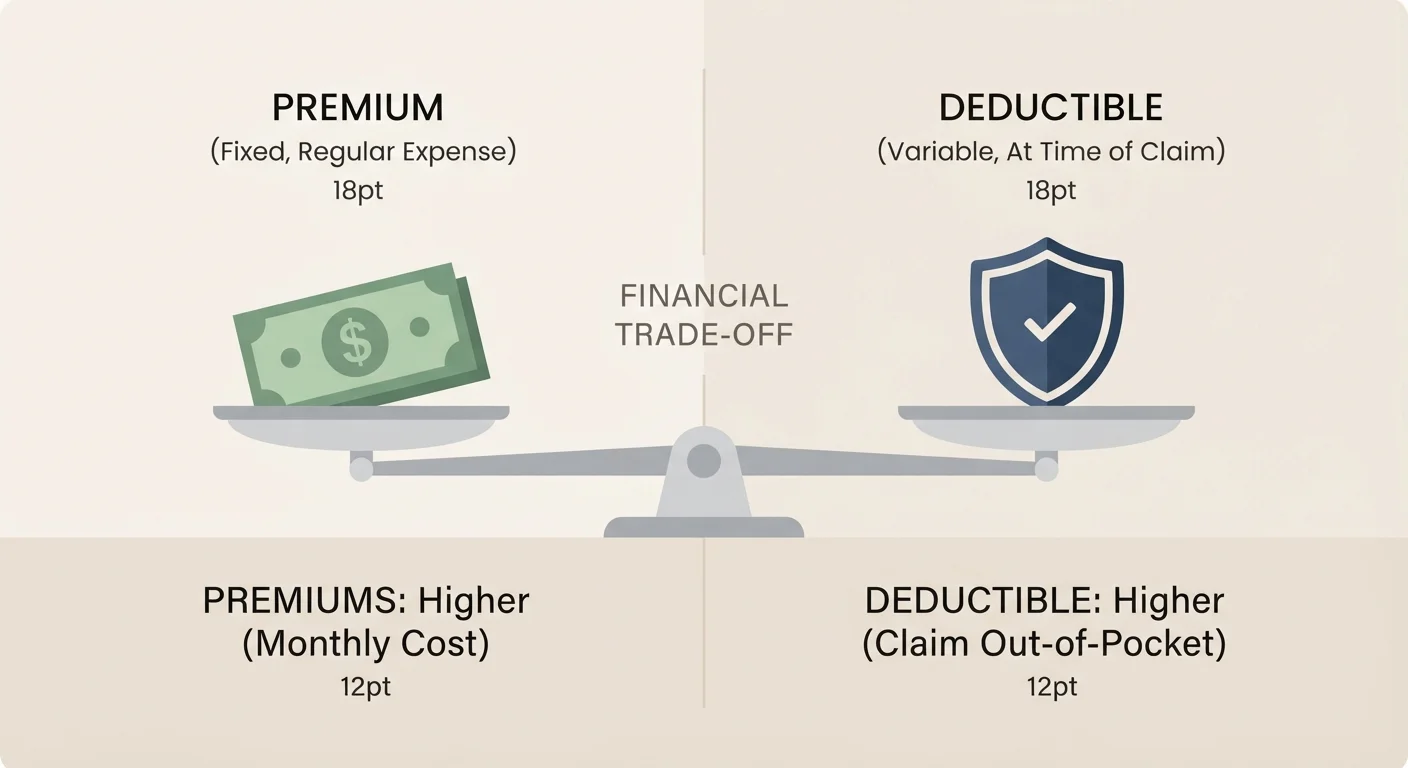
What Each Term Actually Means
Before comparing the trade-off, it helps to lock in exactly what these two terms mean - they often get confused, even by people who've had insurance for years.
Your premium is the amount you pay to maintain your insurance policy - typically billed monthly, every six months, or annually. Think of it as a subscription fee for coverage. You pay it whether or not you ever file a claim.
Your deductible is the amount you agree to pay out of pocket before your insurer covers the rest of a covered claim. For example, if you have a $500 deductible and a covered repair costs $2,000, you pay $500 and your insurer pays $1,500. If the repair costs less than your deductible, insurance doesn't pay anything - you cover it entirely.
Deductibles apply separately to different types of coverage. Comprehensive and collision coverage each carry their own deductible. Liability coverage - which pays for damage you cause to others - typically does not have a deductible at all. For a full breakdown of these terms in context, see the Car Insurance Glossary for plain-language definitions you'll actually encounter on a real policy.
How the Trade-Off Works
The relationship between deductibles and premiums is inverse: when one goes up, the other tends to go down. Insurers calculate your premium based on their expected risk - how much they might have to pay out on your behalf. When you agree to absorb more of that cost yourself (via a higher deductible), you reduce the insurer's exposure, and your premium reflects that.
| Criterion | High Deductible | Low Deductible |
|---|---|---|
| Monthly premium | Lower | Higher |
| Out-of-pocket cost at claim time | Higher (e.g. $1,000+) | Lower (e.g. $250-$500) |
| Best savings cushion needed | Larger emergency fund required | Smaller cushion acceptable |
| Financial risk if accident occurs | Higher short-term exposure | Lower short-term exposure |
| Long-term cost if few claims filed | Often lower overall | Often higher overall |
| Suitable for financed/leased vehicles | Riskier without savings | Generally more manageable |
Common deductible amounts in auto insurance range from $250 to $1,500, though $500 and $1,000 are the most frequently chosen options. The premium difference between a $500 and $1,000 deductible varies by driver, location, and insurer, but it's often meaningful enough to factor into your budget. That said, premium differences vary significantly based on your driving record, location, vehicle type, and the insurer - so treat any example figures as illustrative, not guaranteed.
Understanding what else affects your premium is important context here. See what factors you can and cannot control when it comes to your premium for a fuller picture.
$500
Most common auto insurance deductible amount
According to the Insurance Information Institute, $500 is the most frequently selected deductible level among US auto policyholders.
~15-30%
Typical premium reduction for doubling deductible
The Insurance Information Institute notes that raising a deductible from $200 to $500 can reduce collision and comprehensive costs by 15-30% on average, though results vary widely by insurer and driver profile.
How to Think Through the Decision
The central question isn't which option is cheaper - it's which option you can actually handle financially if something goes wrong.
Ask yourself: Could I pay my deductible today?
If your deductible is $1,000 and you don't have $1,000 accessible in savings, that deductible is effectively unaffordable. In an accident scenario, you'd face the added stress of scrambling for funds on top of the accident itself. If that describes your situation, a lower deductible is likely worth the higher premium - even if it feels like more money going out each month.
Consider how often you're likely to file a claim
If you drive a short commute, park off-street, and have a clean record, your probability of filing a claim in any given year is relatively low. That shifts the math toward a higher deductible: you're less likely to need it, and the premium savings accumulate over time. Conversely, if you drive frequently in high-traffic or high-risk conditions, the odds of eventually needing to use your coverage increase.
Factor in your vehicle's value
If you drive an older vehicle with low market value, a high deductible may not make practical sense for collision or comprehensive coverage - if the car is only worth $4,000 and your deductible is $2,000, the coverage provides limited benefit after a total loss. This connects directly to the question of whether full coverage is even worth carrying. The article Liability-Only vs Full Coverage: When Each One Makes Sense walks through this calculation clearly.
A Note on Emergency Funds and Insurance
Financial advisors generally suggest keeping three to six months of expenses accessible as an emergency fund. If you haven't built that cushion yet, your deductible decision is especially important - a high deductible without savings to back it up can turn a minor accident into a financial crisis. If you're working on building savings alongside managing insurance costs, the Credit & Debt hub covers foundational money management strategies that can help.
Before committing to any policy, use the pre-purchase checklist for young drivers to compare deductible and premium combinations side by side across policies.
This article is for general informational purposes only and does not constitute personalized insurance or financial advice. Coverage terms, deductibles, and premiums vary by insurer, policy, and individual circumstances. Consult a licensed insurance agent for guidance specific to your situation.