
What Is a Fixed-Rate Mortgage?
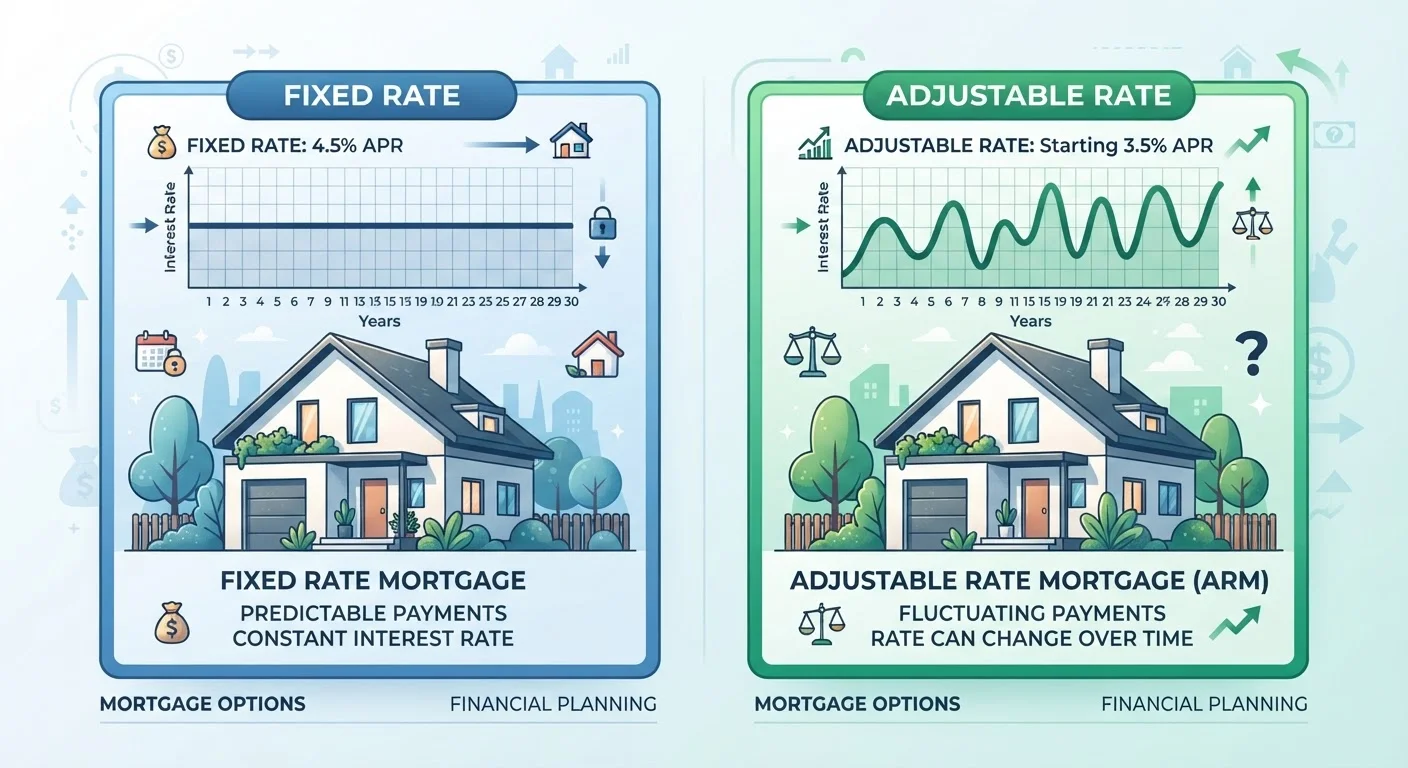
A fixed-rate mortgage is a home loan where your interest rate stays exactly the same for the life of the loan — whether that's 10, 15, or 30 years. Because the rate never changes, your principal-and-interest payment (the core portion of your monthly bill) remains identical every month.
This predictability is the defining feature. You can budget years in advance knowing exactly what you owe. The trade-off is that fixed rates are typically set slightly higher than the introductory rates offered by adjustable-rate mortgages, because the lender is absorbing the risk of future rate swings on your behalf.
The 30-year fixed-rate mortgage is by far the most common loan type in the US. A 15-year fixed is also widely available and comes with a lower interest rate but a higher monthly payment, since you're paying the loan off in half the time. Understanding how your mortgage payment fits into your broader budget is easier when the number doesn't move — for a deeper look at fixed vs. variable costs in general, see our guide to fixed vs. variable expenses.
Principal vs. Interest: A Quick Definition
Your monthly mortgage payment is made up of several parts. "Principal" is the portion that reduces your loan balance. "Interest" is the cost the lender charges for the loan. With a fixed-rate mortgage, the split between principal and interest shifts over time (you pay more interest early on), but the total payment amount stays constant. Other costs — property taxes, homeowner's insurance, and possibly private mortgage insurance — are separate and can change year to year.
What Is an Adjustable-Rate Mortgage (ARM)?
An adjustable-rate mortgage (ARM) starts with a fixed interest rate for an initial period — commonly 5, 7, or 10 years — and then adjusts periodically based on a financial market index plus a set margin. You'll often see these written as 5/1 ARM or 7/6 ARM.
Here's how to read that shorthand: the first number is the length of the initial fixed period in years; the second number is how often the rate adjusts after that (a "1" means once per year, a "6" means every six months). So a 5/1 ARM keeps your rate fixed for five years, then re-evaluates annually.
ARMs include built-in rate caps — limits on how much the rate can change at each adjustment and over the life of the loan. For example, a cap structure written as 2/2/5 means the rate can rise no more than 2% at the first adjustment, 2% at each subsequent adjustment, and 5% total above your starting rate. Even with these guardrails, your payment can increase meaningfully after the fixed period ends.
To see how ARM loans fit alongside other mortgage options available to first-time buyers, check out our overview of loan types for first-time buyers.
Key Differences at a Glance
The table below lays out the most important distinctions between these two mortgage structures so you can compare them side by side.
| Criterion | Fixed-Rate Mortgage | Adjustable-Rate Mortgage (ARM) |
|---|---|---|
| Interest rate | Stays the same for the entire loan term | Fixed initially, then adjusts periodically |
| Initial rate level | Typically higher than ARM intro rate | Often lower during the fixed period |
| Payment predictability | Completely predictable every month | Can change after the fixed period ends |
| Rate caps | Not applicable — rate never moves | Per-adjustment and lifetime caps apply |
| Best time horizon | Long-term (10+ years in the home) | Shorter-term (plan to move or refinance) |
| Risk profile | Lower risk of payment increases | Higher risk if rates rise at adjustment |
| Common terms | 15-year or 30-year | 5/1, 7/1, 7/6, 10/1 ARM structures |
~90%
Share of US mortgages that are fixed-rate
According to Federal Reserve and mortgage industry data, the vast majority of American homeowners have traditionally chosen fixed-rate loans.
2–5%
Typical refinancing closing cost range
The Consumer Financial Protection Bureau (CFPB) estimates closing costs for refinancing generally fall between 2% and 5% of the loan amount.
5/1
Most common ARM structure in the US
The 5/1 ARM — fixed for five years, then adjusting annually — is among the most frequently offered adjustable products by US lenders.
How to Think About the Choice
The right mortgage type depends more on your situation than on which product sounds better in the abstract. Ask yourself two questions first: How long do I realistically plan to stay in this home? And how much payment variation could my budget absorb if rates rise?
If you're confident you'll live in the home long-term, a fixed rate eliminates the guesswork. If you're buying a starter home you expect to sell in five or six years — or if you plan to refinance before the ARM's adjustment period begins — the lower initial rate of an ARM might reduce your costs during the time you actually hold the loan.
Keep in mind that refinancing isn't free or guaranteed. It involves closing costs (typically 2–5% of the loan amount) and requires qualifying again at the time you refinance. Rates and your financial profile at that future date may not cooperate with your plan.
The rent-vs-buy decision itself also shapes which loan structure makes sense. If you're still evaluating whether homeownership is the right move, our breakdown of renting vs. buying trade-offs can help you think that through first.
This article is for general informational purposes only and does not constitute personalized financial or mortgage advice. Mortgage products, rates, and terms vary by lender, loan program, and individual financial profile. Always consult a licensed mortgage professional or financial adviser before making decisions about your specific situation.