
Why So Many Drivers Ignore Tire Pressure
Tire pressure sits in an awkward category of car maintenance: it's invisible, easy to forget, and not dramatic enough to feel urgent - until something goes wrong. Unlike a check engine light or a strange noise, slightly soft tires don't announce themselves. The car still drives. So the check gets skipped.
That's a costly habit. The National Highway Traffic Safety Administration (NHTSA) has consistently identified underinflation as a significant factor in tire-related crashes and blowouts. And beyond safety, underinflated tires quietly chip away at fuel efficiency - the U.S. Department of Energy estimates that tires inflated to the correct pressure can improve gas mileage by a small but meaningful amount over time.
The good news: checking tire pressure takes about three minutes and requires almost no mechanical knowledge. It's one of the few maintenance tasks that genuinely belongs in every driver's routine, regardless of experience level. For a broader picture of what happens when basic upkeep gets skipped, see our article on what goes wrong when basic car maintenance gets skipped.
~25%
Pressure drop before TPMS warning triggers
TPMS alerts typically activate only after tire pressure falls about 25% below the recommended level, according to NHTSA guidance.
1 PSI
Pressure lost per 10°F temperature drop
The U.S. Department of Energy notes that tire pressure changes roughly 1 PSI for every 10-degree Fahrenheit shift in outside temperature.
1 in 4
Vehicles with at least one significantly underinflated tire
NHTSA data has indicated that approximately one in four passenger vehicles is operating with at least one tire significantly underinflated.
Understanding the Numbers: PSI and Where to Find It
Every tire has two PSI figures associated with it, and mixing them up is one of the most common mistakes new owners make. The number molded into the tire sidewall - something like "Max. Press. 51 PSI" - is the structural maximum the tire can safely hold, not what you should inflate it to. Filling to that number will leave your tires dangerously overinflated.
The number you actually want is on a sticker inside your driver's side door jamb. It reflects what the vehicle manufacturer determined gives the best balance of ride quality, handling, fuel economy, and safety for that specific car. Front and rear tires sometimes have different recommended pressures, so check both.
Check Pressure Before You Drive, Not After
Heat from driving raises tire pressure temporarily, which can make an underinflated tire appear normal when checked warm. Always check first thing in the morning or after the car has been parked for at least three hours. This gives you an accurate cold reading that matches what the door sticker recommendation is based on.
One more important detail: always check pressure when the tires are cold - meaning the car hasn't been driven for at least three hours. Driving heats up the air inside the tire and temporarily raises the reading, giving you a false number.
How to Actually Check and Adjust Tire Pressure
You don't need a mechanic for this. Here's the basic process:
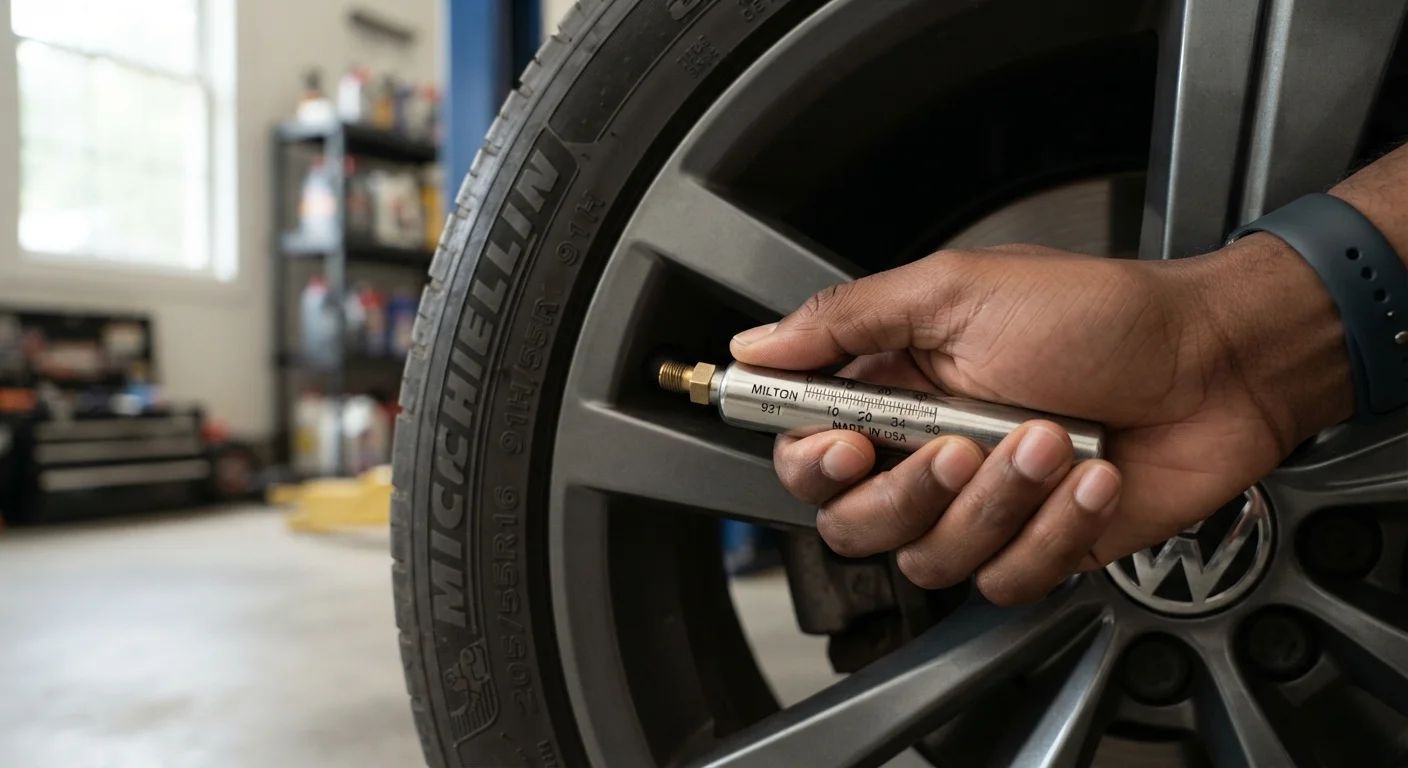
- Get a gauge. A simple pencil-style or digital gauge is inexpensive and far more reliable than eyeballing your tires.
- Remove the valve cap from the tire's valve stem - the small rubber nub near the wheel rim.
- Press the gauge firmly onto the stem. You'll hear a brief hiss, then get a reading. Compare it to the recommended PSI on your door jamb sticker.
- Add air if needed at a gas station air pump or with a portable compressor. Add in short bursts and recheck frequently - it's easy to overshoot.
- Release air if overinflated by pressing the small pin inside the valve stem with a gauge or pen cap.
- Replace the valve cap when done.
This check pairs well with a quick visual scan of your tread - our guide on tyre tread, age, and rotation explains what to look for while you're already crouched down by each wheel.
What Your TPMS Light Actually Tells You (and Doesn't)
Most vehicles made after 2007 are equipped with a Tire Pressure Monitoring System (TPMS) - a dashboard warning light shaped like a cross-section of a tire with an exclamation point. When it lights up, many drivers assume that means their tires are fine until they see it. That assumption is risky.
TPMS alerts are generally triggered when a tire falls roughly 25% below the recommended PSI. For a tire that should sit at 32 PSI, that means the warning may not appear until pressure drops to around 24 PSI - well into underinflated territory. By then, you've already been driving on compromised tires, likely for some time.
Think of the TPMS light as a last resort warning, not a green light. Monthly manual checks are how you stay ahead of the problem. And don't forget that some spare tires - particularly full-size spares - aren't monitored by TPMS at all, so they need manual checks too.
This article is for general informational purposes. Always consult your vehicle's owner's manual and a qualified mechanic for guidance specific to your car.