

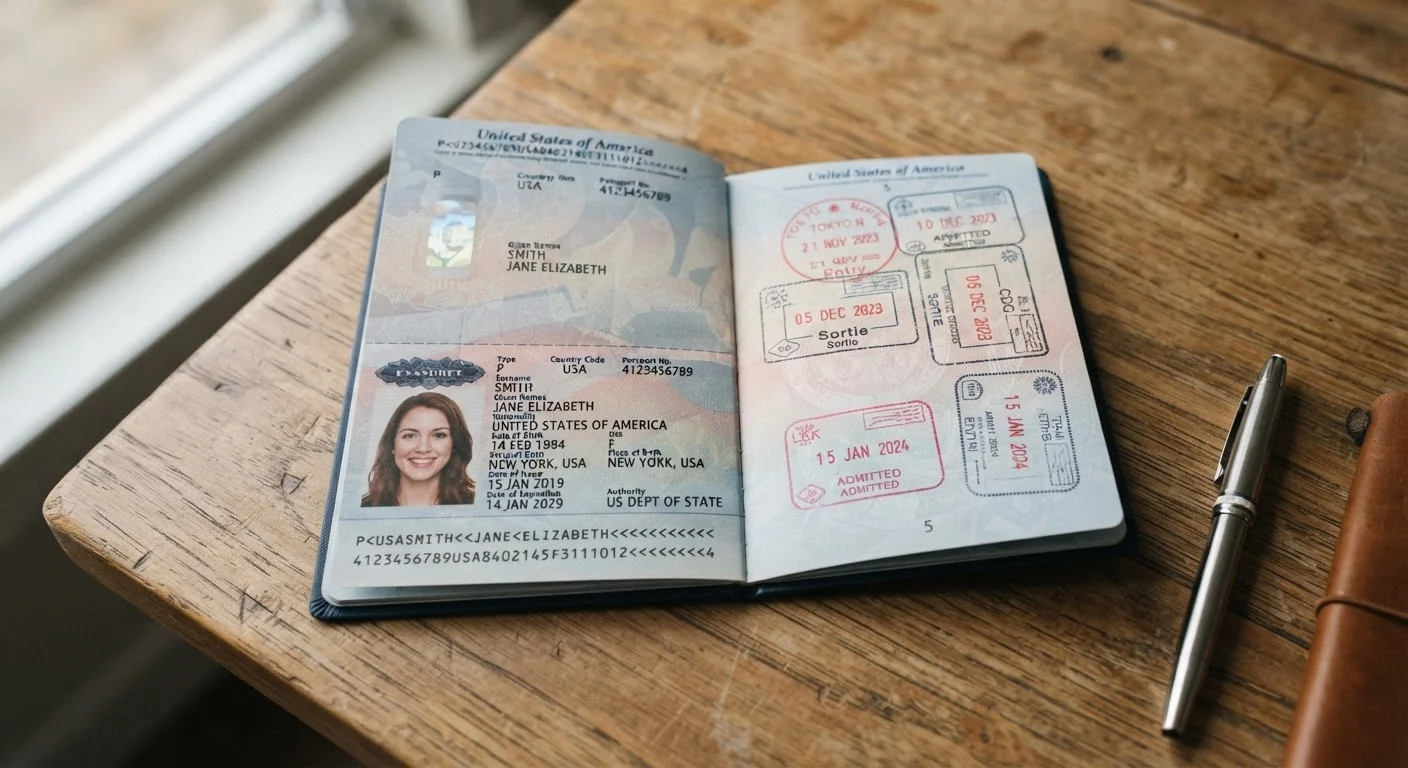
What the Personal Data Page Actually Contains
The page inside your passport's front cover — the one with your photo — is called the personal data page (or biographical data page). Most travelers glance at it to confirm the photo looks like them and move on. But border officers and airline check-in systems read every field carefully.
Here's what's encoded there:
- Full legal name — as it must match your travel tickets exactly
- Date and place of birth
- Issue and expiration dates
- Passport number — a unique identifier used across systems
- Nationality and issuing authority
- Machine-readable zone (MRZ) — the two lines of characters at the bottom that scanners read instantly
The MRZ is more important than it looks. Any physical damage — water warping, a torn corner, ink smears — can prevent scanners from reading it, triggering manual review or outright delays. Keep your passport somewhere it won't get wet, bent, or scratched.
When you're filling out booking forms, your passport number and date of birth must be entered precisely. Even a transposed digit can create a mismatch that causes friction at check-in. Our guide on fields that seem optional but aren't explains where these errors tend to happen.
Expiration Dates Don't Mean What You Think
Your passport's expiration date tells you when the U.S. government considers the document no longer valid. It does not tell you when other countries will stop accepting it.
Most countries apply what's commonly called the six-month validity rule: your passport must remain valid for at least six months beyond your intended departure from their country. If your passport expires in four months and you're planning a two-week trip, you may still be denied boarding — even though your passport is technically valid the day you fly.
6 months
Minimum passport validity many countries require beyond departure
This is a widely applied rule across destinations in Europe, Asia, and Latin America — though the exact requirement varies by country and should be verified through official sources.
10 years
Standard U.S. adult passport validity
Passports issued to U.S. citizens age 16 and older are valid for ten years from the date of issue, according to the U.S. Department of State.
5 years
U.S. passport validity for children under 16
Because children's appearances change rapidly, U.S. passports issued to applicants under age 16 carry a shorter five-year validity period.
Some countries require only 90 days of remaining validity; others require six months regardless of trip length. The rules are set by individual governments and can change. Before any international trip, verify the specific requirement for your destination using the U.S. Department of State's travel information pages or the destination country's official immigration resources.
U.S. passports are valid for 10 years for adults (16 and older) and 5 years for children under 16. If you're approaching the end of that window, renewing well before your travel date is the safest move.
Why Blank Pages Can Make or Break Your Trip
Visas — whether issued as paper stickers placed inside your passport or stamps applied at the border — take up physical space. Once your passport runs out of blank pages, you have a problem.
Many countries, especially those that issue entry and exit stamps, require one or two fully blank pages as a condition of entry. Some specify that the blank pages must be facing each other (a double-page spread). If you arrive without enough space, border officers can and do turn travelers away.
Check Your Page Count Before Every Trip
Before any international trip, count your passport's remaining blank pages — not just whether the passport is valid. Aim to have at least four blank pages available when you depart, to account for visas, entry stamps, and exit stamps across your destinations. If you're close to running out, apply for a new passport before you book your flights.
If your passport is running low on pages, the solution is to apply for a new passport — the U.S. no longer offers a page-addition service. You don't need to wait for your passport to expire; you can renew it early. The old passport (with its visa history) is returned to you cancelled, which can be useful if you need to show previous travel records.
As you plan any trip, flip through your passport and count the blank pages honestly. Factor in stamps you'll receive entering and exiting each country, and any visas you'll need to affix before departure. Make sure you have enough margin. Our pre-departure paperwork checklist includes a passport review step to catch issues like this before you reach the airport.
What Your Passport Can't Tell You
A valid passport is necessary for international travel — but it doesn't guarantee entry into any country. Border officers have the authority to deny entry for reasons entirely separate from your document's validity. Your passport also doesn't tell you:
- Whether you need a visa — this depends on your destination and your citizenship. U.S. passport holders travel visa-free to many countries, but not all.
- What vaccinations or health documentation a country requires — some destinations require proof of vaccination (such as yellow fever) as a condition of entry.
- What customs rules apply — limits on cash, goods, or restricted items vary by country.
- Current travel advisories or entry restrictions — conditions change. A country that was unrestricted when you booked may have new requirements by your departure date.
Think of your passport as the minimum requirement — the starting point, not the finish line. Verify all entry conditions for your destination through official sources before you travel, and store a copy of your passport securely in a separate location. Our guide on keeping travel documents safe covers how to manage physical and digital backups while you're on the move.