

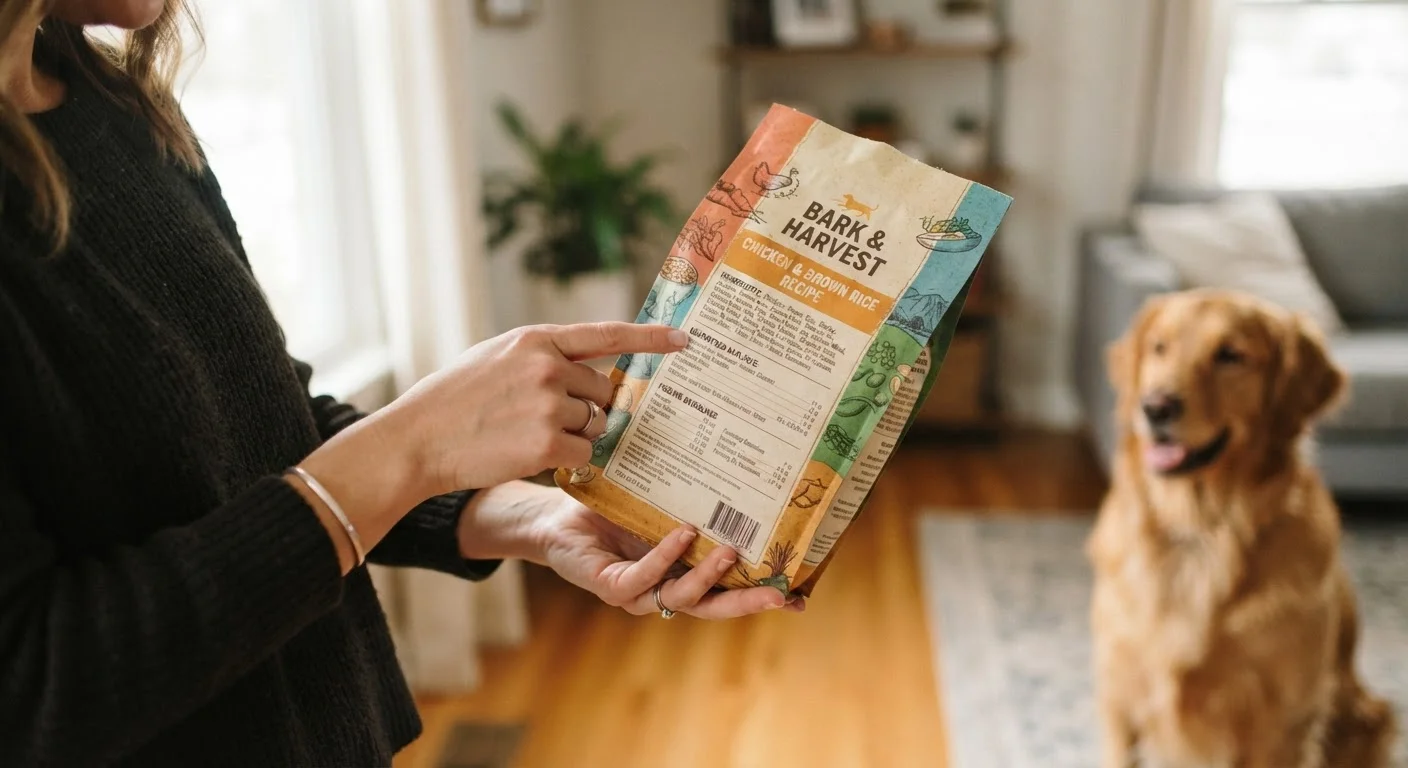
Why the Ingredients List Matters More Than the Front of the Bag
The front of a pet food bag is marketing. Words like "premium," "natural," or "wholesome" carry no regulated definition in the U.S. pet food industry. The real information is on the back — in the ingredients list and the guaranteed analysis panel.
Pet food sold in the U.S. is regulated at the federal level by the FDA and at the state level through standards set by the AAFCO. AAFCO doesn't approve individual products, but it publishes ingredient definitions and nutrient profiles that most states adopt into law. That means there's a consistent framework for what ingredients must be called and how nutritional claims are made — once you know how to read it.
If you're still deciding what type of food to feed, our overview of dry, wet, and raw diets explains the trade-offs between formats before you get into label specifics.
| Regulatory body for pet food in the U.S. | FDA (federal) and AAFCO model standards (state-adopted) |
| Ingredient listing order | By pre-cooking weight, heaviest first |
| Typical moisture in dry kibble | Around 10% |
| Typical moisture in wet/canned food | 75–80% |
| Key adequacy statement life stages | Adult maintenance, Growth (puppy/kitten), All life stages (AAFCO model regulations) |
| Natural preservatives commonly used | Mixed tocopherols (vitamin E), rosemary extract |
How to Read the Ingredients List
Ingredients are listed by weight in descending order — the heaviest ingredient comes first. This sounds straightforward, but moisture content complicates things. A fresh chicken ingredient may weigh a lot before cooking because it contains a lot of water; after processing, its actual contribution to the finished food may be smaller than it appears.
Protein Sources
Look for a named meat or fish as the first ingredient: "chicken," "salmon," or "lamb" rather than generic "meat" or "poultry." Named sources are more traceable and regulated. "Chicken meal" is a concentrated, dried form of chicken — it has less moisture than fresh chicken, so its protein contribution by weight can actually be higher than fresh chicken listed first.
Meal vs. By-Product
"Chicken meal" means rendered, dried chicken flesh. "Chicken by-product meal" includes other parts — organs, feet, and undeveloped eggs — which are nutritious but lower-grade than muscle meat. By-products aren't necessarily harmful, but named meals are generally considered a more consistent protein source.
Fillers and Carbohydrates
Grains, potatoes, peas, and lentils serve as energy sources and binders. They aren't inherently bad — dogs digest carbohydrates reasonably well — but if multiple grain or starch sources appear in the first five ingredients, protein may be less prominent than it looks. Cats are obligate carnivores and need diets higher in animal protein.
AAFCO
The Association of American Feed Control Officials. A non-governmental body that publishes model regulations and nutrient standards widely adopted by U.S. states to govern pet food labeling and formulation.
Guaranteed Analysis
A required panel on pet food labels showing minimum crude protein and fat percentages, and maximum fiber and moisture percentages. It describes nutrient levels but not ingredient quality.
Dry Matter Basis
A method of comparing nutrients in pet foods after accounting for their moisture content, allowing fair comparison between wet and dry formulas.
Crude Protein
A measurement of total nitrogen in food used to estimate protein content. 'Crude' refers to the measurement method, not the quality or digestibility of the protein.
Nutritional Adequacy Statement
A required label statement indicating whether a food is 'complete and balanced' for a specific life stage, and whether that claim is based on nutrient profiles or a feeding trial.
Obligate Carnivore
An animal that biologically requires nutrients found only in animal tissue. Cats are obligate carnivores and need diets higher in animal protein than dogs.
Preservatives and Additives
Natural preservatives include mixed tocopherols (vitamin E) and rosemary extract. Synthetic options like BHA, BHT, and ethoxyquin are approved for use but some owners prefer to avoid them. Vitamins and minerals listed near the end of the ingredients list are typically added to meet AAFCO nutrient profiles — their presence is a sign the food is nutritionally complete, not a red flag.
The Guaranteed Analysis Panel
Below or beside the ingredients list, you'll find the guaranteed analysis: minimum percentages of crude protein and crude fat, and maximum percentages of crude fiber and moisture. "Crude" means the measurement method — not a quality judgment.
"Crude" Doesn't Mean Low Quality
The word "crude" in guaranteed analysis terms (crude protein, crude fat) refers to the chemical method used to measure those nutrients — not the quality of the ingredients. A food with high crude protein from named meat sources is very different from one achieving the same number through lower-quality inputs. The ingredients list tells you more about quality; the guaranteed analysis tells you about quantity.
To compare wet and dry foods fairly, you need to convert both to a dry matter basis. Wet food is typically 75–80% moisture, so its nutrient percentages look lower. Subtract the moisture percentage from 100, then divide the nutrient percentage by that number. For example: a wet food with 10% protein and 78% moisture → 10 ÷ (100 − 78) = about 45% protein on a dry matter basis.
The AAFCO Nutritional Adequacy Statement
This short line is one of the most important things on the label. It tells you whether the food is "complete and balanced" for a specific life stage — "adult maintenance," "growth" (puppies/kittens), or "all life stages." It also tells you how that was determined: either by meeting AAFCO nutrient profiles (a calculated approach) or by passing a feeding trial. Both are acceptable; feeding trials involve actual animals eating the food over time.
If a bag says "for supplemental feeding only" or has no adequacy statement, it isn't formulated as a complete diet and shouldn't be a pet's sole food source.
Food costs are one of the recurring expenses new owners underestimate — see our breakdown of what pet ownership actually costs to plan realistically.
Practical Steps for Evaluating a Label
- Check the adequacy statement first. Is the food complete and balanced for your pet's life stage?
- Identify the first protein source. Is it a named meat or meal?
- Count how many protein sources appear in the first five ingredients. More named animal proteins relative to starches generally signals a more meat-forward formula.
- Note the moisture percentage if comparing wet and dry options, and use dry matter math to make a fair comparison.
- Look for vitamin and mineral supplements near the end of the list — their presence means the food is formulated to meet nutritional targets.
If your pet has a known food sensitivity or allergy, your veterinarian is the right person to help you identify appropriate limited-ingredient or novel-protein diets. Label reading can support that conversation, but it doesn't replace professional guidance. For broader health questions, our pet health and vet hub covers when and why to see a vet.
This article provides general educational information about pet food labeling and is not a substitute for personalized veterinary nutrition advice. Consult your veterinarian before making significant changes to your pet's diet, especially if your pet has a health condition.