

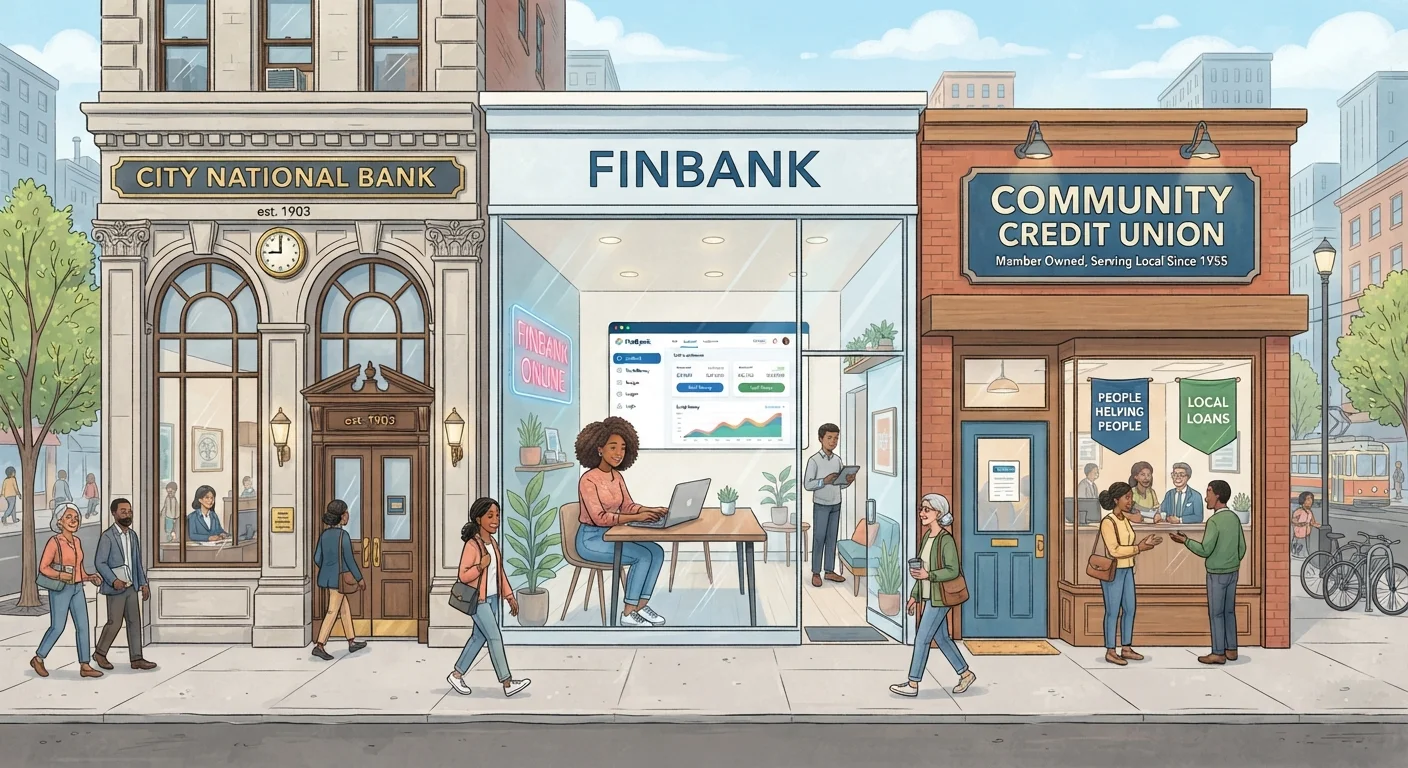
How These Three Institution Types Work
When you're ready to open your first account, you'll quickly discover that not all financial institutions are built the same. Understanding the basic structure of each type helps you make a choice that fits your life — not just whoever has the closest branch.
Traditional banks are for-profit companies chartered by state or federal regulators. They earn revenue by lending out deposited money at interest. In return, depositors get access to a wide network of branches and ATMs, along with a broad menu of products — checking, savings, loans, mortgages, and credit cards — all under one roof.
Online banks operate without physical branches, conducting all business through apps and websites. Because they don't pay for real estate or large in-person staff, they pass those savings to customers through lower fees and — often — higher interest rates on savings accounts.
Credit unions are nonprofit, member-owned cooperatives. When you join a credit union, you become a partial owner. Profits are returned to members in the form of lower loan rates, higher deposit rates, and reduced fees. Membership is typically tied to an employer, community, or organization, though many credit unions have expanded eligibility broadly. For a deeper look at accounts you'd open at any of these institutions, see our guide to checking vs. savings accounts.
Comparing the Key Differences
The table below lays out how traditional banks, online banks, and credit unions stack up across the criteria that matter most to new account holders.
| Traditional Bank | Online Bank | Credit Union | |
|---|---|---|---|
| Physical branches | Widely available | None | Limited, varies by institution |
| ATM access | Large proprietary networks | Partner ATM networks, often fee-reimbursed | Shared branch/ATM networks |
| Monthly fees | Common; often waivable | Rare or none | Low to none |
| Savings interest rates | Often below national average | Frequently above national average | Competitive, member-dependent |
| Loan rates | Varies; market-driven | Varies; not always offered | Often favorable for members |
| Deposit insurance | FDIC up to $250,000 | FDIC up to $250,000 | NCUA up to $250,000 |
| Membership requirement | None | None | Yes — varies by credit union |
| Best for cash deposits | Yes — easy in-branch | Limited or indirect | Yes — in-branch or shared network |
One detail worth highlighting: both bank types (traditional and online) are insured by the FDIC, while credit unions are insured by the NCUA. In both cases, deposits are protected up to $250,000 per depositor, per institution. This is a foundational safeguard you should confirm before opening any account — our checklist for evaluating a bank walks through what to verify.
Check Deposit Insurance Before You Open an Account
Whether you choose a bank or credit union, always confirm it carries FDIC or NCUA insurance before depositing money. Legitimate institutions will display this information clearly on their website or in branch materials. Uninsured deposits are not protected if the institution fails.
What to Prioritize Based on Your Situation
There's no universally right answer, but your priorities can point you in a clear direction.
- If you handle cash regularly or want face-to-face help: A traditional bank's branch network is genuinely useful. Depositing cash at an ATM or online-only institution can be cumbersome.
- If you're building an emergency fund or want to grow savings faster: Online banks frequently offer APY rates on savings accounts that are meaningfully higher than the national average at traditional banks. Even a fraction of a percent matters over time.
- If you're planning to borrow — for a car, for instance — or want lower fees: Credit unions often offer competitive loan terms. This is worth comparing if you're also exploring financing a vehicle through your own bank vs. a dealership.
- If you value digital convenience above everything else: Online banks are built for mobile-first users. Most offer robust apps, instant transfer tools, and 24/7 account access.
Many people also use more than one institution — for example, a checking account at a local credit union and a high-yield savings account at an online bank. There's no rule against it, and it's a legitimate way to capture benefits from multiple types. This article is part of our broader complete overview of banking and savings if you want to keep building from here.
4,600+
Federally insured credit unions in the U.S.
According to the National Credit Union Administration (NCUA), thousands of federally insured credit unions operate across the country, serving communities of varying sizes.
$250,000
Standard deposit insurance limit per depositor
Both the FDIC and NCUA insure deposits up to $250,000 per depositor, per insured institution, per ownership category — a key consumer protection regardless of which institution type you choose.
This article is for general informational and educational purposes only and does not constitute personalized financial advice. For decisions specific to your financial situation, consider consulting a qualified financial professional.