

Why Credit Score Myths Spread So Easily
Credit scores touch almost every major financial milestone — renting an apartment, financing a car, qualifying for a mortgage. Yet the way they actually work is poorly understood by most people, including many who already have credit cards and loans. That gap between how common credit scores are and how rarely anyone explains them clearly is exactly where myths take root.
Some misconceptions are passed down from well-meaning family members whose information is simply outdated. Others arise from misreading a marketing email or confusing two different credit concepts. Either way, acting on bad information can quietly hold your score back or cost you real money in interest.
The good news: once you know how scores are actually calculated, the myths tend to collapse quickly. For a solid foundation, see our credit scores explained guide. Then work through the myths below.
Myth
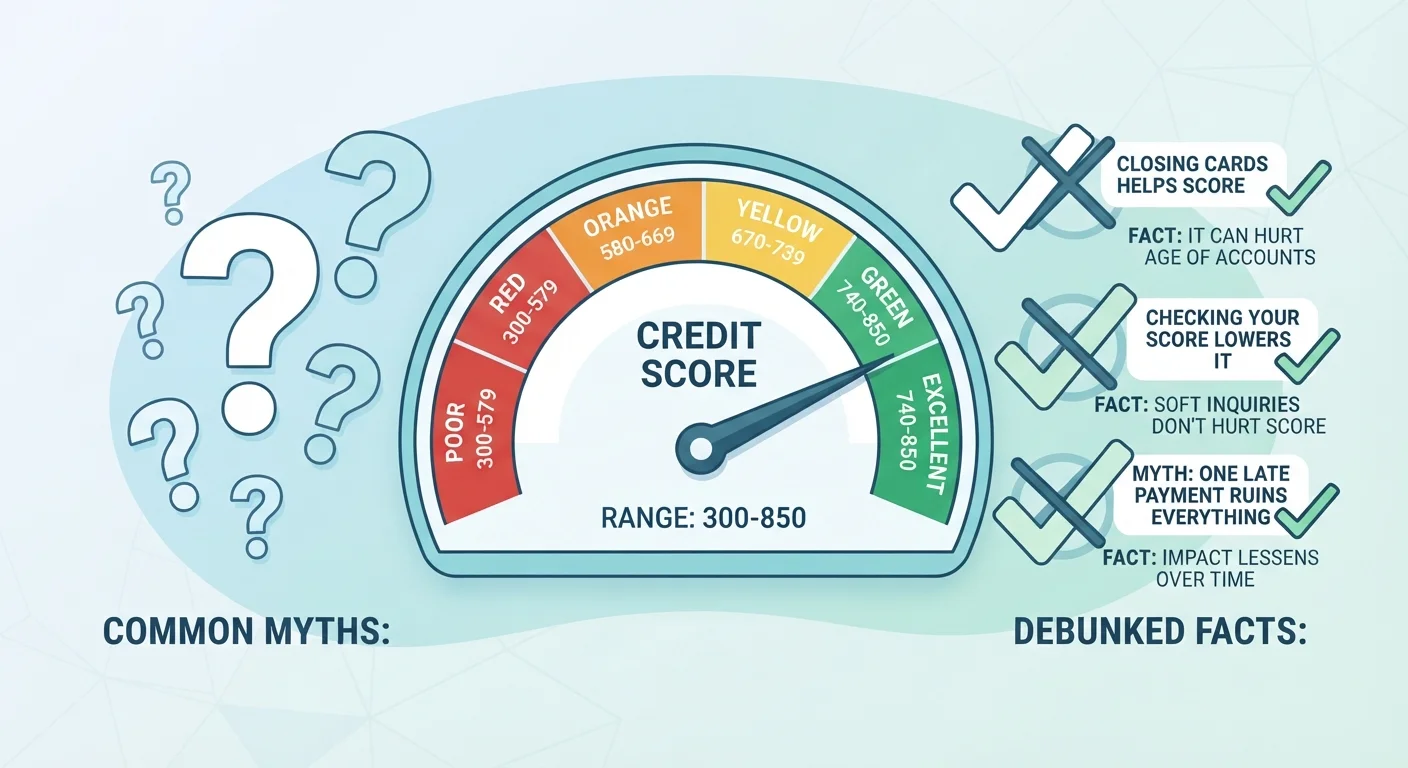
Checking my own credit score will lower it.
Fact
Checking your own score is a 'soft inquiry' and has zero effect on your credit score.
There are two types of credit inquiries: hard and soft. A hard inquiry happens when a lender checks your credit because you've applied for new credit — a card, loan, or mortgage. Hard inquiries can temporarily lower your score by a few points. A soft inquiry occurs when you check your own score, or when a company pre-screens you for an offer. Soft inquiries are invisible to lenders and do not affect your score at all. Checking your score regularly is actually a healthy habit — it helps you catch errors and track your progress. See our guide on how credit applications affect your score for more on hard vs. soft pulls.
Myth
Carrying a small balance on my credit card each month helps build my score.
Fact
Carrying a balance provides no scoring benefit and simply costs you interest charges.
This is one of the most persistent and costly credit myths. Lenders do not reward you for paying interest. What matters to your score is that you use your card and pay on time — not that you leave a balance sitting there accruing interest. Paying your statement balance in full each month demonstrates responsible use, keeps your utilization low, and avoids unnecessary interest costs. There is no strategic reason to carry a balance month to month. If you are currently carrying one, strategies for controlling credit card debt can help you reduce it methodically.
Myth
Closing a credit card I don't use will improve my score.
Fact
Closing an old account often hurts your score by reducing your total available credit and shortening your credit history.
When you close a card, two things can happen to your score. First, your total available credit decreases, which may raise your overall credit utilization ratio — and higher utilization typically lowers your score. Second, if the closed card was one of your older accounts, closing it can shorten your average account age over time, which is another factor lenders consider. If a card has an annual fee you no longer want to pay, contact the issuer to ask about downgrading to a no-fee version of the same card rather than closing it entirely.
Myth
You need a high income to have a good credit score.
Fact
Income is not a factor in any credit scoring model. Scores are based entirely on how you manage credit, not how much you earn.
Credit bureaus — the organizations that compile your credit report — do not collect income data. Neither the FICO Score nor VantageScore (the two most widely used scoring models in the U.S.) includes income, employment status, or net worth as inputs. A person earning a modest salary who pays every bill on time and keeps utilization low can have an excellent score. Conversely, a high earner who misses payments or maxes out credit cards may have a poor one. This means building good credit is accessible regardless of where you are financially right now.
Myth
You need a perfect 850 score to get the best rates.
Fact
Lenders typically offer their best terms to borrowers above a certain threshold — often around 740 to 760 — not just to those with a perfect score.
While an 850 is technically the highest possible FICO Score, lenders generally sort applicants into tiers rather than treating each point as meaningfully different. In practice, borrowers who reach the 'excellent' credit tier — a range that varies by lender but commonly starts around 740 to 760 — tend to qualify for the most favorable interest rates. Chasing a perfect score beyond that threshold yields little practical benefit. A more useful goal is consistent, on-time payment and low utilization, which naturally moves you into that competitive range over time.
What Actually Moves Your Score — and What Doesn't
Understanding the real drivers of your score makes it much easier to separate fact from fiction. Payment history — whether you pay on time — carries the most weight. Credit utilization, meaning how much of your available credit limit you're using, is the next biggest factor. Our article on credit utilization explains this in detail.
Other factors include the length of your credit history, the mix of account types, and recent applications for new credit. None of these factors involve your income, your savings account balance, or how often you look at your own score. For a full breakdown of each factor and its weight, visit The Five Factors That Shape Your Credit Score.
~35%
Weight of payment history in FICO scoring
According to FICO's published scoring breakdown, payment history is the single largest factor in a standard FICO Score calculation.
~30%
Weight of credit utilization in FICO scoring
FICO's published model identifies amounts owed — closely tied to credit utilization — as the second most influential scoring factor.
Multiple Applications in a Short Window Add Up
Each time you apply for a new credit card or loan, the lender performs a hard inquiry. One inquiry has a modest, temporary impact. But applying for several credit products within a short period can compound that impact and signal financial stress to lenders. Rate-shopping for mortgages or auto loans is generally treated differently — most scoring models group multiple inquiries of the same type within a short window as a single inquiry — but this protection does not typically extend to credit card applications.
If you're unsure how to read the report that underpins your score, our credit report walkthrough breaks it down section by section.
This article is for general informational purposes only and is not personalized financial advice. For guidance specific to your situation, consult a licensed financial professional.