

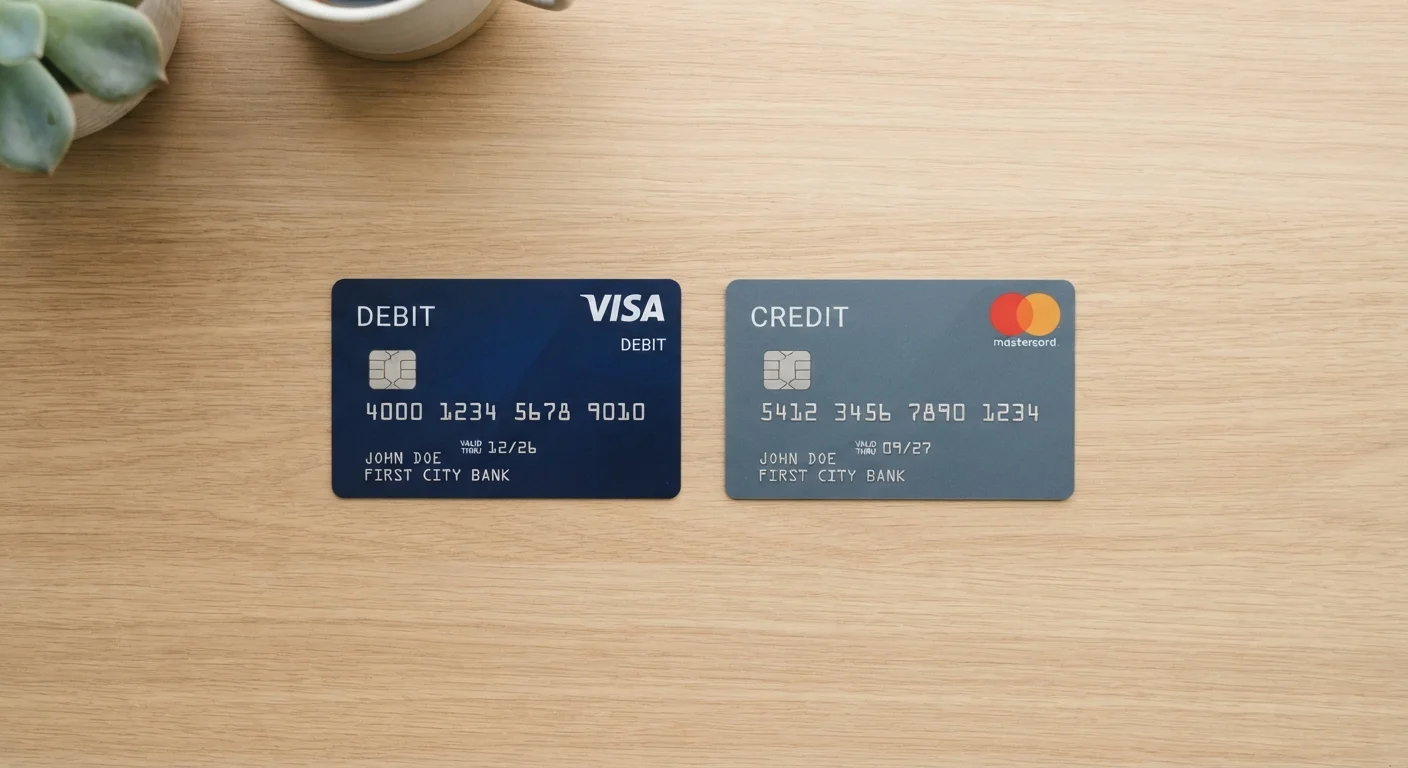
How Each Card Actually Works
The plastic looks the same, the PIN pad looks the same — but the financial mechanics are entirely different.
A debit card is linked directly to your checking account. When you swipe or tap, the money leaves your account within one to two business days. You are spending funds you already own. If the balance isn't there, the transaction is either declined or, if you've opted into overdraft coverage, processed with a fee attached. To understand more about the account your debit card connects to, see our guide to checking vs. savings accounts.
A credit card works differently. When you use it, the card issuer pays the merchant on your behalf, and you take on a short-term debt. Once a month, you receive a statement. If you pay the full balance by the due date, no interest is charged. If you pay only part of the balance, the remainder carries over and begins accumulating interest — typically at a high annual percentage rate (APR).
In short: debit draws from your money today; credit is a loan you repay later.
| Criterion | Debit Card | Credit Card |
|---|---|---|
| Funds source | Your checking account balance | A credit line from the issuer |
| Overspending risk | Limited to your balance (or overdraft) | Can spend up to your credit limit |
| Interest charges | None | Accrues if balance is not paid in full |
| Fraud liability | Time-sensitive; funds already gone | Stronger protections; unpaid charge disputed |
| Builds credit history | No | Yes, when used responsibly |
| Rewards programs | Rarely | Common on many cards |
| Risk of debt | Low (no credit extended) | Real if balances are carried |
Fraud Protections: Where They Differ Most
This is one of the most practical differences for everyday consumers, and it's often overlooked.
Under the Fair Credit Billing Act (FCBA), credit card holders have a legal right to dispute fraudulent or incorrect charges and can withhold payment on disputed amounts while the issuer investigates. Your maximum liability for unauthorized charges is capped at $50 by law — and most issuers waive that entirely.
Debit card protections exist under the Electronic Fund Transfer Act (EFTA), but they are more time-sensitive. If you report fraud within two business days, your liability is capped at $50. Wait between three and 60 days and it can rise to $500. Beyond 60 days, you may bear responsibility for all losses. Crucially, with a debit card, the money has already left your account — meaning you're waiting to get your own funds back, not disputing a charge you haven't yet paid.
Watch Out for Debit Holds
Some merchants — particularly hotels, gas stations, and car rental companies — place a temporary authorization hold on your account when you pay with a debit card. This hold can freeze more money than the final charge and may take several days to release. The same hold on a credit card doesn't touch your actual cash. This is worth keeping in mind when traveling or booking accommodation.
This distinction matters especially for online purchases, hotel holds, and car rentals — situations where a merchant might place a hold that temporarily freezes funds in a checking account but would simply sit as an unused authorization on a credit card.
Credit Cards and Your Credit History
One thing a debit card cannot do — regardless of how responsibly you use it — is build your credit history. Debit transactions are not reported to the three major credit bureaus (Equifax, Experian, and TransUnion).
A credit card, when used carefully, does the opposite. Every on-time payment is recorded. The ratio of your balance to your credit limit (called your credit utilization ratio) is tracked. Over time, this activity forms the credit history that lenders, landlords, and even some employers look at when evaluating you.
If you're ready to take that step, our guide to getting your first credit card walks through what to look for and what to avoid. And if you're concerned about managing a balance, keeping credit card debt under control covers the habits that prevent interest from becoming a problem.
~83%
US adults who own at least one credit card
According to Federal Reserve survey data, the majority of American adults carry at least one credit card, making understanding how they work a core financial literacy skill.
$5,000+
Average credit card balance per US borrower
Federal Reserve and industry data consistently show average revolving balances in the thousands, underscoring how quickly unpaid balances can accumulate at typical APRs.
It's worth noting: credit card debt is not the same as all debt. Some forms of debt — like student loans or a mortgage — can serve constructive purposes. For a broader view, see our article on good debt vs. bad debt.
This article is for general informational and educational purposes only and does not constitute personalized financial or legal advice. Consult a qualified financial professional for guidance specific to your situation.