
The Original Idea: Why Envelopes?
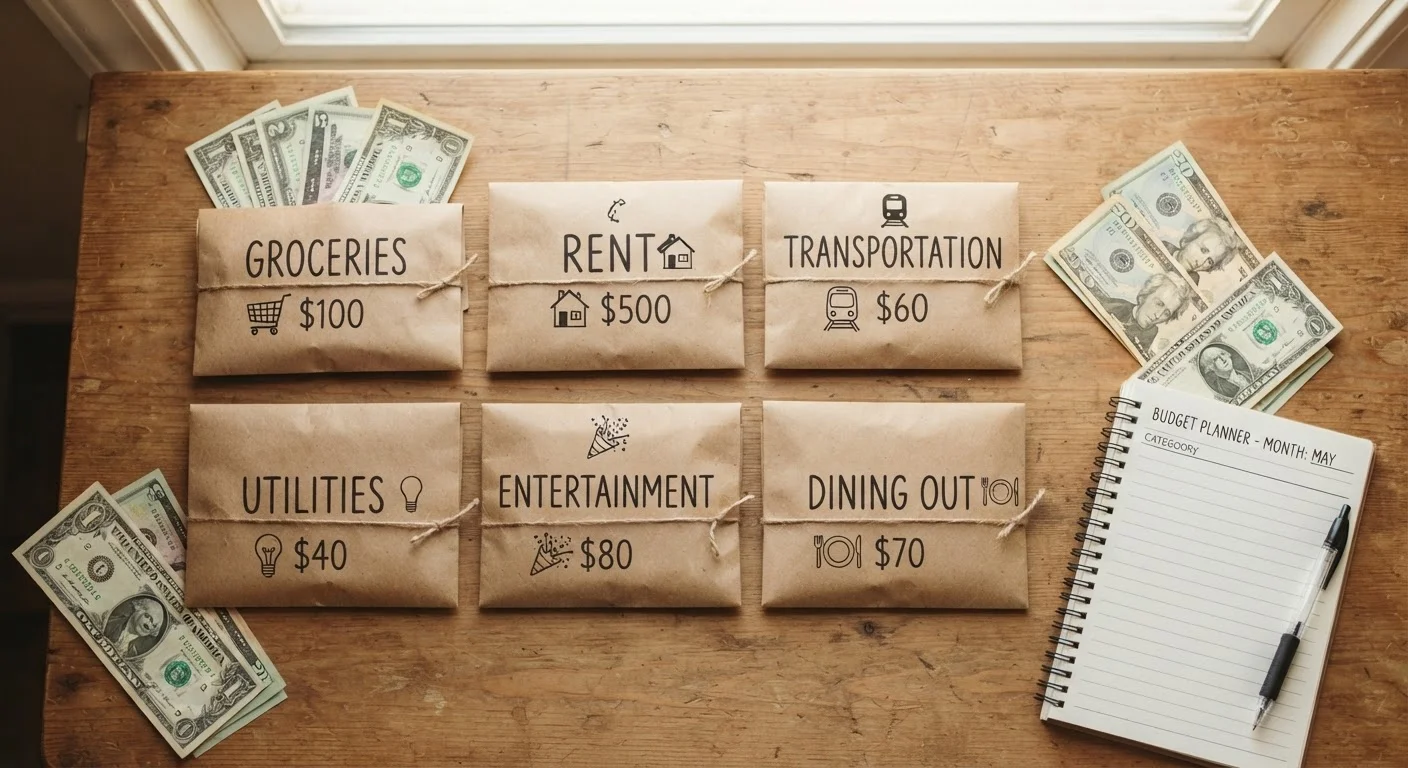
Before debit cards and banking apps, many American households managed spending by dividing their paycheck into labeled envelopes. Each envelope represented a different part of their budget - one for the electric bill, one for food, one for clothing. When the money in a given envelope ran out, spending in that category stopped. It was a simple, physical constraint that prevented overspending without requiring any financial expertise.
The underlying insight hasn't changed: people spend more when spending feels abstract. Handing over a $20 bill feels more significant than tapping a card, and watching cash disappear from a labeled envelope is even more visceral. That psychological friction is the system's real power.
If you're building your first budget and want to understand the vocabulary behind methods like this one, the budgeting terms glossary is a useful starting point.
Start with Just Three or Four Envelopes
New to the system? Don't try to create a category for every possible purchase. Begin with the two or three areas where you consistently overspend - typically groceries, dining out, and entertainment. A simpler setup is easier to maintain, and you can always add more categories once the habit feels natural.
How to Set Up an Envelope Budget
Setting up the system takes one focused session at the start of each month. Here's the basic process:
- Calculate your take-home pay. Use your actual net income - what hits your account after taxes and deductions, not your gross salary.
- List your variable spending categories. These are the areas where your spending fluctuates month to month: groceries, gas, dining out, personal care, entertainment, clothing.
- Assign a dollar amount to each category. Base these on your past spending - review a couple months of bank or card statements to get realistic numbers.
- Fund the envelopes. Withdraw the cash and physically place it in labeled envelopes, or enter the amounts into a digital tracking tool.
- Spend only from each envelope. When the grocery envelope is empty, grocery spending stops - or you make a deliberate choice to move money from another envelope.
For a broader look at building your first complete budget, see the step-by-step budget walkthrough for beginners.
1 in 3
Americans have no monthly budget
According to a Gallup survey, roughly one-third of U.S. adults do not track their monthly spending against a budget of any kind.
~$1,500
Average monthly discretionary spending per U.S. consumer
The U.S. Bureau of Labor Statistics Consumer Expenditure Survey indicates that non-fixed, discretionary spending represents a significant share of household outflows - the exact category envelope budgeting targets.
The Digital Version: Same Concept, No Cash Required
Carrying physical cash has become less practical for most people, and that's okay - the envelope concept translates directly to digital tools. Several budgeting apps are built around this exact model, letting you create virtual envelopes or "buckets" for each spending category and log purchases against them in real time.
Even a simple spreadsheet can work: create a column for each category, enter your monthly limit, subtract each purchase, and watch the remaining balance. The discipline comes from checking your balances before you spend, not from the format itself.
One important note: digital envelope systems require honest, timely logging. If you swipe your card and forget to record it, your virtual envelope won't reflect reality. Building a habit of logging purchases - ideally the same day - keeps the system accurate.
Digital Logging Requires Consistency
Unlike cash envelopes that empty automatically, digital systems only work if you record every transaction. A missed entry can make a nearly-empty category look full. Set a daily reminder or log purchases immediately after making them to keep your virtual envelopes accurate.
Curious how this approach compares to other frameworks? The budgeting approaches comparison lays out several popular methods side by side so you can find the structure that suits your habits.
When Envelope Budgeting Works Best - and When It Doesn't
Envelope budgeting is particularly effective if you tend to overspend on day-to-day purchases, feel unclear about where your money goes, or want a method that requires minimal financial background knowledge. It's also well-suited to people who are motivated by visual progress - watching an envelope empty out is a clear, real-time feedback loop.
The method has some natural limits, however. It's less useful for fixed expenses like rent, loan payments, or insurance premiums - those bills don't benefit from an envelope because the amount doesn't change. And if you earn an irregular income, assigning fixed amounts upfront each month can be tricky; you may need to adjust envelopes after each paycheck.
Envelope budgeting is also just one tool. If you want to compare it directly with other approaches like the 50/30/20 rule, the zero-based budgeting vs. 50/30/20 comparison walks through the tradeoffs. And once your budget is in place, building a savings habit is a natural next step - the saving and banking hub covers how to open accounts and grow an emergency fund.
This article is for general informational and educational purposes only and does not constitute personalized financial advice. Consider speaking with a qualified financial professional about decisions specific to your situation.