

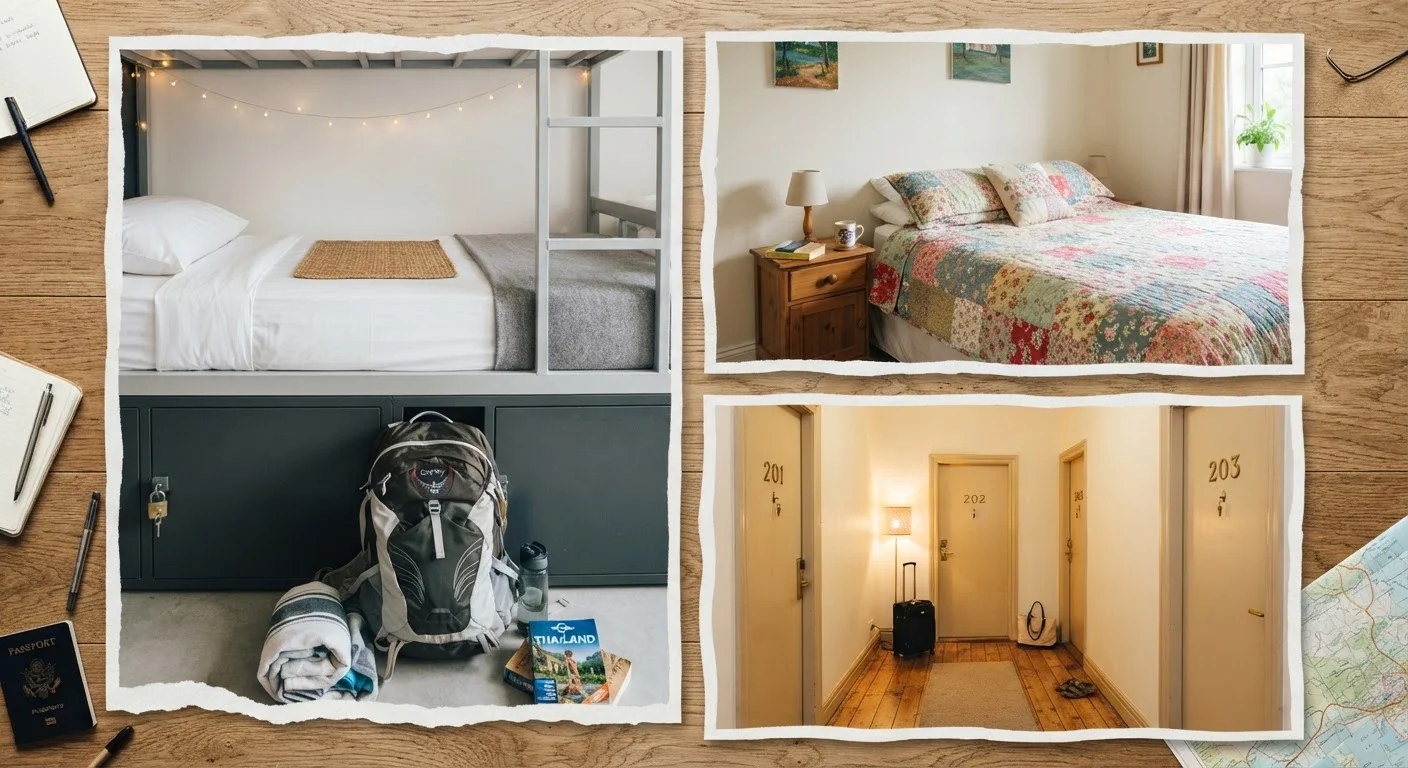
Why the Differences Actually Matter
When you're booking your first trip, filtering by price and clicking "reserve" can feel like enough. But three listings at the same nightly rate can offer completely different experiences — one puts you in a room with seven strangers, one feels like a family home, and one is a plain room with a lock on the door and nothing else.
Understanding what each option actually delivers — not just what the name implies — helps you book with confidence rather than guesswork. If you're still working out your overall spending plan, the pre-trip budget checklist is a solid place to start before committing to anything.
| Hostels | Guesthouses | Budget Hotels | |
|---|---|---|---|
| Typical room type | Shared dorm (private available) | Private room | Private room |
| Bathroom | Shared (usually) | Shared or private | Usually private en-suite |
| Relative nightly cost | Lowest | Low to moderate | Moderate |
| Privacy level | Low | Medium | High |
| Social atmosphere | High — built in | Moderate | Low |
| Breakfast included | Sometimes | Often | Rarely (or extra cost) |
| Quality consistency | Varies by property | Varies widely | More predictable |
| Best for | Solo backpackers | Local-feel seekers | Privacy-focused travelers |
Hostels: Maximum Social, Minimum Privacy
A hostel typically sells beds, not rooms. In a shared dormitory — usually 4 to 12 bunks — you'll sleep alongside other travelers, share bathrooms, and use communal areas like kitchens and lounges. Private rooms are often available at hostels too, but the dorm format is what defines the category.
What you're actually getting: A bed, a locker (sometimes you need your own padlock), access to shared bathrooms, and often a common area where socializing happens naturally. Many hostels include Wi-Fi and a basic breakfast, but this varies — always check the listing.
Who it works for: Solo travelers who want to meet people, anyone traveling for an extended period on a lean budget, and backpackers comfortable with noise and shared spaces. If light sleeping is an issue, bring earplugs — dorm rooms can get loud.
Always Check What's Actually Included
Listings for all three accommodation types can look similar at a glance, but the details diverge fast. Before booking, confirm whether linens and towels are provided, whether breakfast is included or costs extra, and whether lockers (for hostels) require your own padlock. A slightly higher-priced listing that includes breakfast and a private bathroom may cost less overall than a cheap listing with add-ons.
To compare hostels with other no-cost or low-cost lodging arrangements, see what hostels, guesthouses, and couchsurfing each involve.
Guesthouses: Local Character, Variable Standards
A guesthouse is typically a small, privately run property — often someone's home or a family-owned building — with a limited number of rooms rented to travelers. They're common across Asia, Latin America, and Southern Europe, and they range from basic to genuinely charming.
What you're actually getting: A private room, usually with its own key. Breakfast is frequently included, though not always. Bathrooms may be private or shared depending on price point. The owner or a family member is often on-site, which means you get local knowledge and personal service that no hotel can replicate.
What to watch for: Quality is harder to predict than at a chain hotel. Guesthouses live and die by their reviews. Check recent ones specifically — a place that was great two years ago may have changed ownership or quality. Noise insulation between rooms is sometimes minimal.
Budget Hotels: Privacy and Predictability
Budget hotels occupy the middle ground between guesthouses and mid-range hotels. They're usually part of a larger building, professionally managed, and stripped of extras like room service or a pool — but they deliver a private room with a private bathroom, consistent check-in procedures, and a lock on the door.
What you're actually getting: A standard private room, an en-suite bathroom in most cases, and basic amenities (towels, linens, often a TV and air conditioning). Front desk staff are typically available during set hours. Breakfast may be sold separately.
Who it works for: Couples, anyone who values a full night's sleep without disturbance, and travelers who want to know exactly what they're walking into. Budget hotels also make sense when you're arriving late or leaving early and need a reliable, no-fuss base.
For a broader look at how all accommodation types — including apartments — fit different trip styles, the guide on matching accommodation to your trip walks through the decision in more depth.
Making the Call Before You Book
Price matters, but it shouldn't be your only filter. Ask yourself: How much does privacy affect my sleep? Do I want to meet other travelers or decompress alone? Am I comfortable with shared bathrooms? How important is breakfast being included?
Once you've answered those honestly, the right category tends to become obvious. For practical strategies on stretching your accommodation budget further — including when splurging slightly on a private room pays off — visit the Budget Travel Tips hub. And if you're brand new to traveling on a limited budget, Budget Travel From the Ground Up covers the core principles worth knowing before any booking.
~$20–$40
Typical US hostel dorm bed per night
Hostel dorm pricing varies significantly by city and region; major metros like New York or San Francisco trend higher.
60%+
Travelers citing social connections as a hostel benefit
Multiple traveler surveys indicate meeting other travelers is among the most cited reasons for choosing hostel accommodation.